
Published October 27, 2026 · By the RUINIU Quality and OEM Team
Basic fleece jackets and simple windbreakers usually start from a lower planning level when the fabric, color, trims and packaging are still available. Hardshell jackets, ski suits, down jackets and custom-dyed programs need earlier planning, because materials, testing and production slots often have to be reserved before the season starts.
Our standard MOQ is 100 pieces per style and color. Standard bulk lead time is 35–50 days after sample, material and order approval. An in-season reorder can come in shorter or longer, depending on fabric availability, trim allocation, order quantity and our production schedule.
The table in this article shows planning difficulty. It does not show delivery speed, and it is not a statistical ranking.
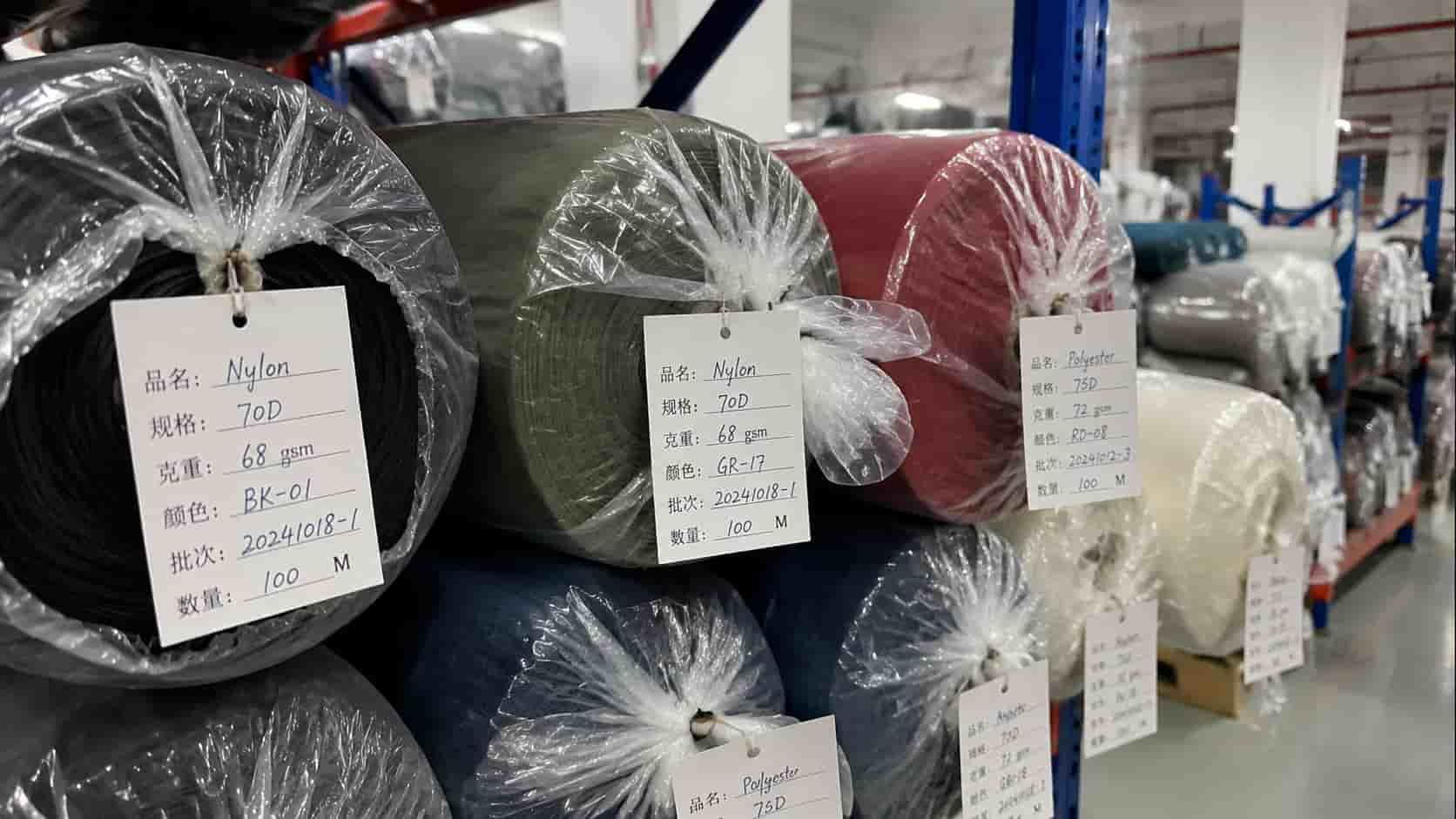
The jacket name tells you little. What matters is fabric availability, dye-lot consistency, insulation, membrane or coating, trims, testing, order quantity and capacity.
A repeat order goes smoothly when the approved sample stays the same. Change the fabric, color, zipper, logo method or performance requirement, and the material usually needs another review before sewing can start.
Material preparation can be a major source of delay, especially for custom-dyed or technical fabrics. When the materials are already on hand, the constraint moves elsewhere: the production slot, testing, or trim availability.
| Jacket type | Common material status | Re-dyeing risk | Re-testing risk | Typical planning starting point | Reserve during the first order |
|---|---|---|---|---|---|
| Basic fleece | Standard fleece may be available | Depends on color lot | Usually low if materials remain unchanged | Lower | Approved color, fabric lot and trims |
| Simple windbreaker | Standard or custom nylon or polyester shell | Medium for custom colors | Depends on finish and market | Lower to medium | Shell fabric, color standard and zippers |
| Softshell jacket | Bonded fabric availability varies | Depends on supplier | Medium if construction changes | Medium | Bonded fabric and key trims |
| Padded jacket | Shell fabric and insulation require allocation | Depends on shell color | Depends on insulation and market | Medium | Shell, insulation and size ratio |
| Down jacket | Down fill and shell require control | Medium | Medium to high if fill or shell changes | Medium to high | Down specification and shell fabric |
| 3-in-1 jacket | Shell and detachable liner are separate components | Depends on both components | Depends on shell construction | Medium to high | Shell, liner fabric, zippers and trims for both parts |
| Hardshell jacket | Membrane and seam tape may be project-specific | Depends on fabric source | More likely when performance changes | High | Membrane, seam tape and test plan |
| Ski suit | Seasonal fabric and capacity need early planning | Depends on fabric and color | Often linked to performance requirements | High | Seasonal materials and production window |
Read the table as a starting point for planning. It is a reference, not a delivery commitment, and each project still needs to be confirmed with the production and purchasing teams. A basic fleece in a newly dyed color can take more planning than a hardshell whose membrane and seam tape are already finished and held.
Two questions place your own order more precisely. Are the materials ready, meaning produced, finished and held, or still to be made? And has anything changed from the approved specification in style, fabric, process or performance requirements?
| Nothing changed | Something changed | |
|---|---|---|
| Materials ready | The limits are the production slot and the standard 35–50 day window. | Re-approval or testing comes first, then production. Time depends on what changed. |
| Materials not ready | Material preparation adds to the timeline, so reserve earlier. | Plan it like a new development order. |
For construction details, see our pages on 3-in-1 outdoor jackets, down jackets and ski suits.
These are starting ranges we use when reviewing materials with buyers. They are not fixed parameters for every style.
Packable windbreaker: 35–70 GSM ripstop nylon
Printed or teamwear shell: 50–90 GSM polyester pongee
Lightweight microfleece: 160–200 GSM
Polar fleece: 240–280 GSM
Hardshell construction: 2-layer, 2.5-layer or 3-layer
A waterproof figure describes the fabric, not the finished jacket. A hydrostatic head value such as 10,000 mm or 20,000 mm applies to the fabric under a stated test method, for example ISO 811. What the finished jacket achieves also depends on seam sealing, zippers and construction. When you specify waterproofing, name the test method and say whether the figure applies to the fabric or the finished garment.
Certification claims also need a scope. For GRS, OEKO-TEX or REACH, ask which material, which supplier and which document the claim covers. A certificate for one fabric says nothing about other components or other production lots.
For reorders this matters because a different lot, finish or supplier means these figures and documents may need to be checked again.
Yes. Stock fabric works for a small launch, urgent sampling, or a reorder in standard colors and common constructions. It can shorten preparation time, but price is only one thing to check.
What you need to know is whether the same fabric will still be there, in the same color, finish and performance level, when the next order goes in.
Before approving stock fabric, ask for:
fiber composition and GSM
available quantity by color
current fabric lot and production date
approved swatch or color reference
finish and coating details
anti-pilling, waterproof or breathability requirements
replacement availability for future reorders
GRS, OEKO-TEX or REACH documents for the specific material, if your market requires them
| Stock fabric question | Why it matters |
|---|---|
| Is the same lot available? | A different lot can show shade or hand-feel variation. |
| Can the supplier reserve the balance? | Without a reservation, the next reorder may need a new fabric search. |
| Is the finish identical? | DWR, coating or brushing differences can affect performance. |
| Are compliance documents available? | Your market may require traceability or documentation. |
| Can the color be reproduced? | A stock color may not come back once the inventory is sold. |
For basic fleece or simple windbreakers, stock fabric is practical if you accept the available color and performance. For custom hardshells, ski suits or technical down jackets, custom or reserved fabric is usually the safer choice, since the membrane, finish, insulation and color all have to stay consistent.
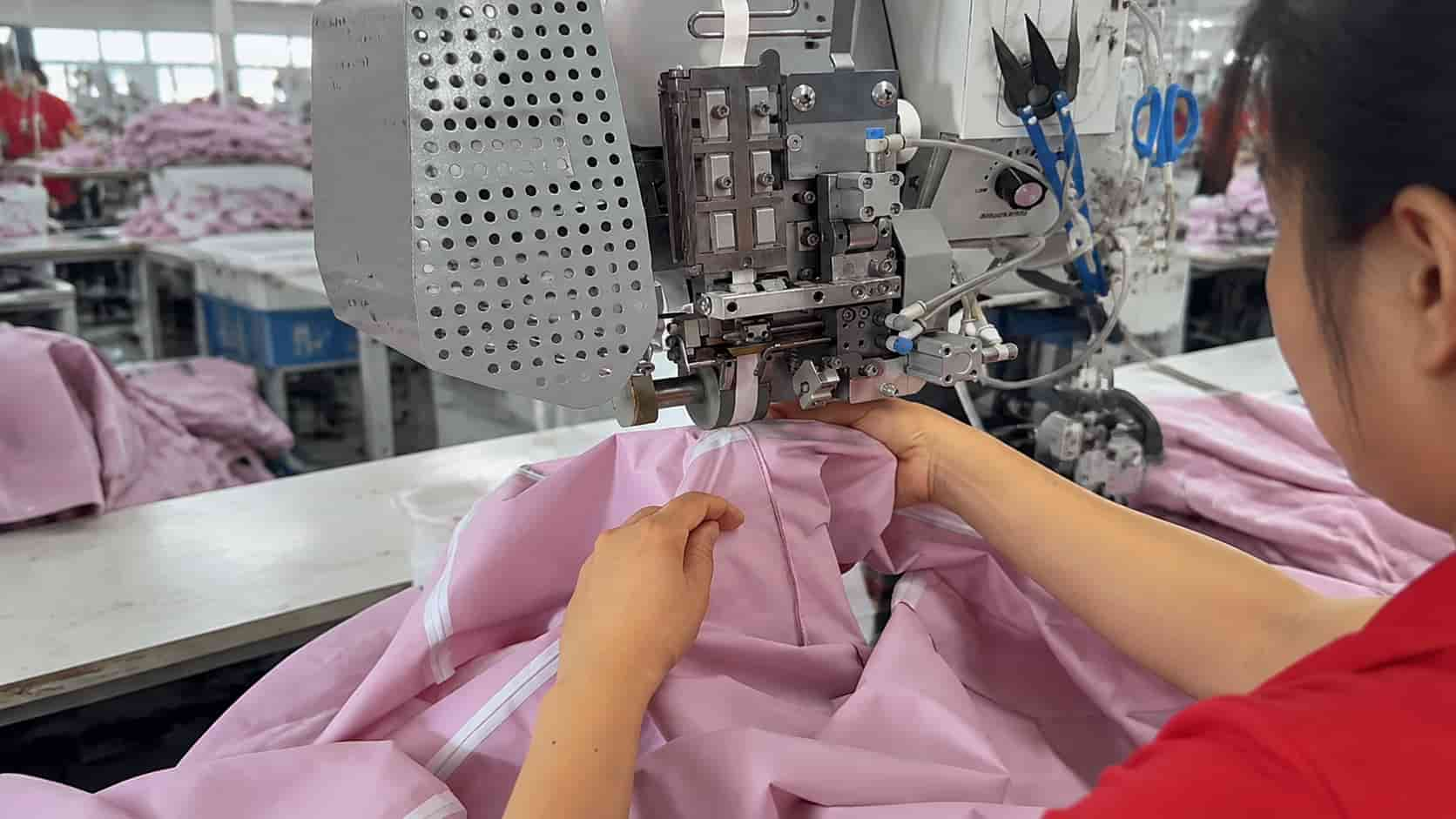
Hardshell and ski garments combine membranes, seam tape, waterproof zippers, insulation and several performance requirements. Change one component and you may trigger a new material review or more testing.
Skiwear is also seasonal. Once the buying season is under way, fabric suppliers and production lines are often already allocated to other programs. A buyer who waits until stock is nearly gone can face a longer material preparation period before any sewing begins.
The same color code can look different between dye lots. We see this most often with custom-dyed nylon, polyester and laminated fabrics.
Before the first bulk order, keep an approved swatch, a color card and a sealed garment reference. Color acceptance can be judged visually under a standard D65 light source or against an agreed color-difference value. Write the acceptance range down with the approved reference, and confirm it before a reorder is released. Our quality control process describes how incoming fabric is checked.
Check zippers, elastic, labels and reflective trims against the approved garment as well. A digital image is not enough.
No. An approved sample fixes the product specification. It does not guarantee that the same fabric, color lot, trims or production capacity will still be available later.
Before releasing a repeat order, reconfirm:
material and color availability
size and color ratios
trims and packaging
testing requirements
production schedule
reorder MOQ
For the sampling stage itself, see how long custom jacket sampling takes.
One European outdoor brand we work with orders custom shell jackets every year and, in recent seasons, has typically placed two or three replenishment orders during the selling season. Its shell fabric is custom-developed, so the brand does not wait until stock is nearly sold out.
Before the season, it confirms expected demand and reserves fabric in advance. The fabric is ready early, so later purchase orders go straight into production planning without waiting for a new fabric development cycle.
The normal 35–50 day bulk production window still applies. What the early reservation removes is the material preparation step, which would otherwise add significant waiting time to each reorder.
100 pieces per style and color is our standard starting MOQ for new orders. It does not mean any 100-piece reorder will repeat the original lead time or unit cost. Three things can change that:
Fabric minimums. Custom-dyed or laminated fabric may be produced in set quantities.
Color quantity. A new color, or a split across several colors, may behave like a new order.
Trim and accessory minimums. Custom zippers, labels and packaging can have their own limits.
Confirm the reorder MOQ, price basis and lead time in writing when you place the first order.
Latest reorder release date = date stock must be available − transit and receiving time − bulk production time − material preparation time − re-approval time
Each part has its own boundary:
Bulk production time. Our standard 35–50 days counts from approval of the sample, materials and order details. It leaves out fabric that still has to be produced, dyed or finished, and it leaves out transport.
Material preparation time. This is zero only when fabric and trims are already produced, finished, tested where required and held for your order. Reserving a quantity does not by itself mean the fabric exists.
Re-approval time. Depending on what has changed from the approved specification, a reorder may still need a sample check, testing, trim reconfirmation or a production slot.
Transit and receiving time. This depends on your route and forwarder, so use your own figure.
Illustrative example with assumed figures, not a delivery promise. Say stock must be available on Day 0, transit and receiving take 25 days, and bulk production takes 50 days (the upper end of the standard range).
| Scenario | Assumption | Release the order about |
|---|---|---|
| A | Fabric and trims are finished and held; nothing has changed | 75 days before Day 0 |
| B | Fabric still needs 30 days of preparation | 105 days before Day 0 |
Both scenarios assume re-approval time is negligible. Add it if your reorder involves any change.
The two scenarios differ by one variable. Material status is often the biggest one, but when materials are ready, the production slot, testing or trims can set the timeline instead. Confirm the actual figures with us for each project.
Possibly. It depends on fabric minimums, color quantity, trim availability and production efficiency. Our standard MOQ is 100 pieces per style and color for new orders. If you want a lower reorder quantity, agree it before the first collection launches.
Our standard bulk lead time is 35–50 days after sample, material and order approval. An in-season reorder can be shorter or longer, depending on fabric availability, trim allocation, order quantity and production capacity.
Not automatically. The same color code can differ between dye lots, especially on custom-dyed nylon, polyester and laminated fabrics. Keep an approved swatch, color card and sealed garment reference, and agree the acceptance range before the reorder is released.
Hardshell jackets and ski suits, because membranes, seam tape, insulation and seasonal fabric need early allocation. Down jackets, 3-in-1 jackets and custom-dyed programs also need advance planning.
The approved shell fabric and color, key zippers, labels and packaging, plus your expected reorder quantity and color ratio. For technical garments, add the membrane, seam tape and test plan.
If a jacket uses standard fabrics and common trims, an in-season reorder is easier to organize. If it uses custom-dyed fabric, membranes, down filling, seam taping or seasonal materials, reserve fabric and production capacity before the selling season begins.
To start a reorder review, send the approved sample, material details, target quantity, color ratio and required delivery date to the RUINIU OEM team.