

Quick Answer
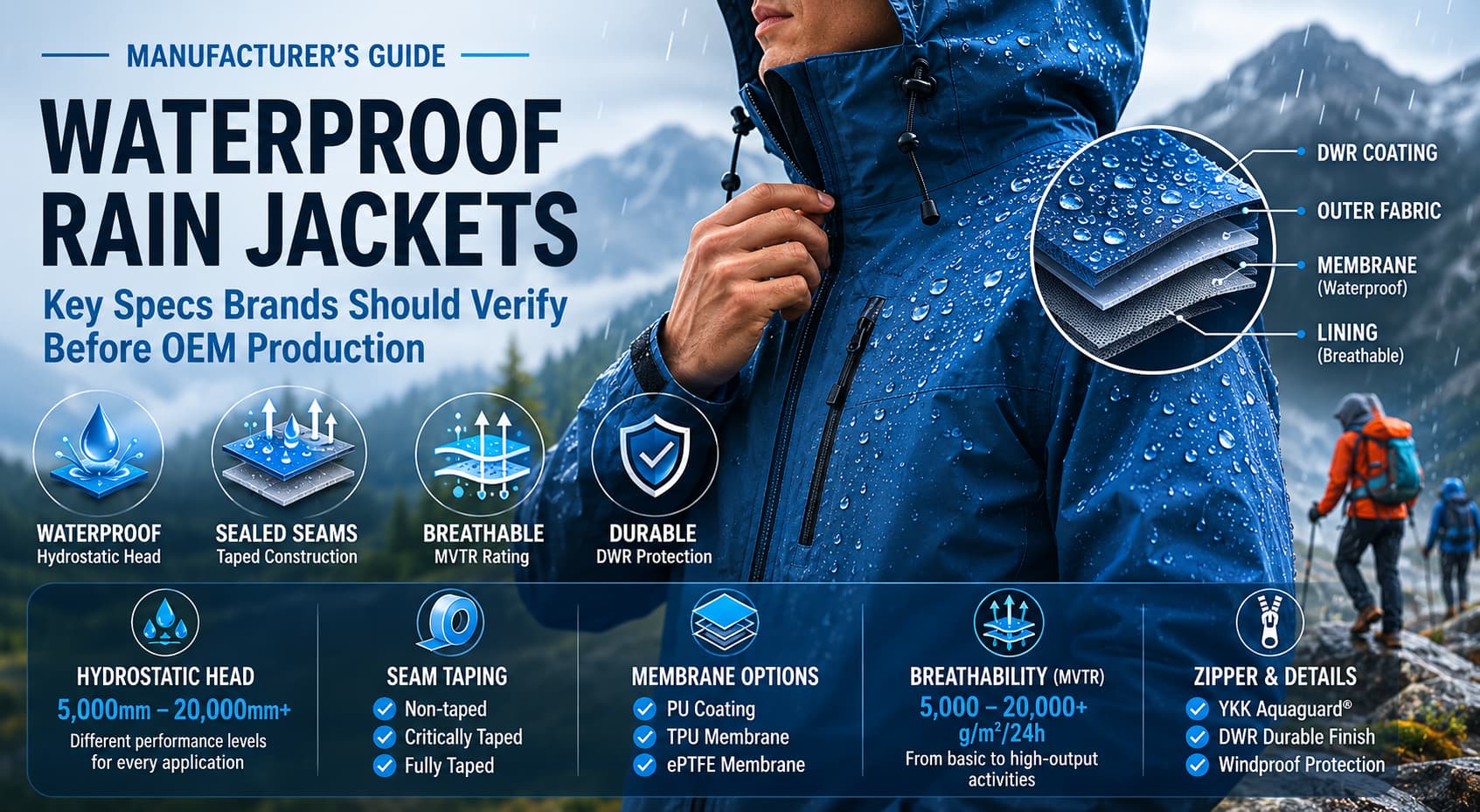
Before OEM production, verify the fabric waterproof rating and test method, membrane or coating, seam-taping coverage, breathability, DWR finish and finished-garment test plan. A high fabric rating alone does not make a waterproof rain jacket if seams, zippers or construction allow water to enter.
Waterproof performance is one of the most misunderstood specifications in outdoor apparel. Brands sourcing custom rain jackets frequently encounter inconsistent supplier claims, unclear rating systems, and products that fail in the field. This guide clarifies the technical standards that actually matter — and what to verify before placing a bulk OEM order.
What "Waterproof" Actually Means in Garment Manufacturing
In garment manufacturing, "waterproof" is not a binary property. It is a measurable performance range defined by standardized tests. A jacket described as waterproof by one supplier may perform very differently from another, depending on fabric construction, coating type, seam treatment, and zipper specification.
Three factors determine the real-world waterproof performance of any rain jacket:
The hydrostatic head rating of the outer fabric
The seam construction and taping method
The membrane or coating technology used
Each can be specified, tested, and verified independently.
Waterproof Testing Standards
Common international testing standards for waterproof outdoor jackets include:
| Standard | Origin | Method |
|---|---|---|
| AATCC 127 | USA | Static water pressure test |
| ISO 811 | International | Hydrostatic pressure test |
| JIS L1092 | Japan | Low and high pressure water resistance |
Brands sourcing OEM rain jackets should confirm which testing method suppliers use when quoting waterproof ratings. The same fabric can return different numbers under different standards — understanding which standard applies prevents misaligned expectations between buyer and manufacturer.
Hydrostatic Head Ratings: What the Numbers Mean
Hydrostatic head (HH) rating measures how much water pressure a fabric can withstand before moisture penetrates, expressed in millimeters.
| Rating | Performance Level | Recommended Use |
|---|---|---|
| 1,500mm – 2,000mm | Light waterproofing | Urban rain jackets, light drizzle |
| 5,000mm – 8,000mm | Mid-range waterproofing | Hiking, general outdoor use |
| 10,000mm – 15,000mm | High performance | Trail running, skiing, heavy rain |
| 20,000mm+ | Technical waterproofing | Mountaineering, extreme weather |
For brands positioning products as performance outdoor jackets, 10,000mm is the minimum credible rating. Anything below 5,000mm should be marketed as casual or urban rainwear only.
Seam Construction Standards
Fabric waterproof ratings are only as effective as the seam treatment. Untaped seams are the most common point of water ingress in otherwise well-constructed jackets.
| Seam Type | Description | Best For |
|---|---|---|
| Non-taped | Standard stitching, no sealing | Budget casual jackets |
| Critically taped | High-stress seams taped only | Mid-range outdoor jackets |
| Fully taped | All seams sealed with waterproof tape | Technical performance jackets |
For any jacket claiming 10,000mm+ waterproofing, fully taped seams are the expected standard. Confirm seam taping specification in the tech pack before sampling begins.
Membrane and Coating Options
PU Coating (Polyurethane)
Applied directly to the inner face of the fabric. Cost-effective and suitable for mid-range products. Breathability is limited compared to membrane constructions. Common base fabrics include polyester pongee and ripstop nylon.
TPU Membrane (Thermoplastic Polyurethane)
A thin film laminated between fabric layers. More durable than coatings with better breathability. Standard in performance outdoor jackets at 10,000mm+ ratings. Compatible with ripstop nylon, Taslon, and Oxford fabric constructions.
ePTFE Membrane (expanded Polytetrafluoroethylene)
Highest-performance option used in technical mountaineering and extreme weather products. Significantly higher cost, suited for premium brand positioning.
For most brands sourcing custom waterproof jackets, TPU membrane at 10,000mm–15,000mm with fully taped seams delivers the best balance of performance, durability, and production cost.
Outer Fabric Constructions
The outer shell fabric affects durability, weight, packability, and waterproof coating adhesion. Common options in OEM rain jacket production:
| Fabric | Weight | Characteristics |
|---|---|---|
| Ripstop nylon | Light | Tear-resistant grid weave, excellent packability |
| Polyester pongee | Light–mid | Smooth hand feel, good DWR retention |
| Taslon | Mid | Abrasion-resistant, matte finish |
| Oxford fabric | Mid–heavy | Durable, structured, suited for workwear |
Fabric choice should align with end-use positioning — lightweight ripstop for packable trail jackets, Oxford constructions for workwear and corporate uniform applications.
Breathability Standards
Breathability is measured by Moisture Vapor Transmission Rate (MVTR), expressed in grams per square meter per 24 hours (g/m²/24h).
| MVTR Rating | Performance Level |
|---|---|
| 5,000 g/m²/24h | Basic breathability |
| 10,000 g/m²/24h | Mid-range active use |
| 20,000 g/m²/24h+ | High-output activities |
Specify MVTR requirements alongside hydrostatic head ratings when briefing manufacturers. The two specs together define the jacket's actual performance envelope.
Key Specs to Verify Before OEM Production
Before approving samples or committing to bulk production, confirm the following with your manufacturer:
Hydrostatic head rating and applicable test standard (ISO 811 / AATCC 127 / JIS L1092)
Seam taping specification (critically taped or fully taped)
Membrane or coating type and fabric supplier
MVTR rating with supporting test data
Zipper waterproofing standard: YKK Aquaguard, SBS waterproof zipper, or reverse coil zipper
DWR finish and wash durability rating (number of wash cycles before re-treatment required)
Outer fabric construction and weight (ripstop nylon / Taslon / polyester pongee)
Fabric layer construction (2.5L or 3L)
Ruiniu provides fabric test reports and mill certifications for all materials used in bulk production. Third-party pre-shipment inspection is supported upon request.
OEM and ODM Rain Jacket Production at Ruiniu
Ruiniu manufactures custom waterproof rain jackets, 3-in-1 outdoor jackets, and softshell jackets for brands across Europe, North America, and Australia. Our OEM service covers the full specification range — from 5,000mm urban rain jackets through to 20,000mm technical shell jackets with fully taped seams and ePTFE membranes.
MOQ: 100 pieces per style per color
Sample lead time: 7–10 business days
Custom branding, labeling, and compliance documentation included
Need a Reliable Waterproof Jacket Manufacturer?
Share your target waterproof rating, fabric requirements, or tech pack with our team. We'll recommend suitable fabric constructions and provide OEM sampling support based on your market positioning.