
Every outdoor apparel manufacturer will send you a capability deck that says the same things: ISO certified, competitive pricing, fast turnaround, full OEM and ODM service.
None of that tells you whether they can actually make your jacket — or whether they'll still be answering your emails six weeks after you wire the deposit.
This guide is for sourcing managers and brand founders who have been through at least one production cycle and know the difference between what a factory claims and what it delivers. We've compared the most frequently referenced outdoor apparel manufacturers — not by ranking them from best to worst, but by explaining what each one is genuinely good at and which type of brand they actually serve.
Outdoor apparel sourcing has shifted significantly over the past five years.
The pattern used to be straightforward: large brand equals large factory, small brand finds a trading company, everybody complains about quality and repeats the process next season.
That model is breaking down. Growing outdoor brands are demanding the same technical standards — seam-sealed waterproof construction, certified insulation, compliant retail packaging — at order volumes that large multinational factories have never been set up to handle. At the same time, brands are placing more value on sampling speed and development flexibility than on raw production capacity.
The result is a clearer split between two types of manufacturers: large-scale operations built for volume, and specialized technical factories built for capability. Knowing which type your brand needs before you start making calls will save you months of wasted time.
How many pieces are you ordering per style, per season?
Under 500 pieces: Most large manufacturers will not work with you at this volume — or they'll take your inquiry, spend three weeks going back and forth, and then quietly tell you their actual minimum is 2,000. Specialized technical factories with flexible MOQ are the realistic option.
500 to 3,000 pieces: You're in the middle zone. Large multinationals may engage with you, but you'll rarely be a priority account. Mid-size specialist factories at this volume can often offer faster sampling and more responsive account management.
Above 5,000 pieces per style: The full range of manufacturers becomes accessible to you. This is where multinational factory conversations become genuinely productive.
Know your number. It eliminates options faster than any other filter.
It isn't choosing the wrong factory. It's approving a sample without verifying it was made on the actual production line.
A factory's sample room is staffed by their best pattern maker and most experienced operator. The sample is perfect — clean seams, correct hand-feel, proper waterproof construction. You approve it and pay the deposit.
Bulk production runs on a different floor. Different supervisor. Workers who joined three weeks ago.
The jackets arrive. Seams aren't properly sealed. The fit is slightly off. The DWR coating is inconsistent across the batch.
This happens in every tier of manufacturing. The factories that have solved it have one thing in common: their pre-production sample is made from actual bulk fabrics, by the same team that will run the bulk order.
Ask every factory you evaluate: "Will my pre-production sample be made from bulk fabrics or sample room stock?" The answer tells you more than any capability document.
If you're sourcing technical outerwear, this matters more than anything else in this guide.
Most factories that describe their products as "waterproof" are offering one of three things — and only one of them is actually waterproof:
Water-resistant (DWR coating only): The fabric surface repels light rain. The seams are completely open. In sustained rain, water enters through every stitch hole within 20 minutes. This is the most common construction in the market.
Waterproof fabric with seam sealing: The shell is a genuine waterproof membrane — 2-layer or 3-layer laminate. Seams are sealed with a hot-air seam-sealing machine. This is real waterproof construction. Most factories claiming this capability either outsource the seam sealing step or don't have the equipment at all.
Fully seam-sealed with hydrostatic pressure testing: The above, plus the finished garment is tested under water pressure to verify no leaks. This is what a performance outdoor brand's end customer actually needs, and what most technical outdoor retailers now require for product certification.
When you evaluate any factory for waterproof outerwear, ask to see their seam-sealing machine on a live video call. If they cannot show it operating on the production floor, they do not have one — and your "waterproof" jackets are not genuinely seam-sealed.
| Manufacturer | MOQ | OEM | ODM | Waterproof Jackets | Ski Suits | Softshell | Down Jackets | Private Label | Best For |
|---|---|---|---|---|---|---|---|---|---|
| Youngone Corporation | 5,000+ | ✓ | Limited | ✓ | ✓ | ✓ | ✓ | Limited | Global tier-one brands |
| Luenthai Outfitters | 2,000+ | ✓ | ✓ | ✓ | Limited | ✓ | ✓ | ✓ | High-volume lifestyle outdoor |
| TAL Apparel Limited | 2,000+ | ✓ | Limited | Limited | ✗ | ✓ | Limited | ✓ | Performance lifestyle / shirts |
| Crystal International | 1,500+ | ✓ | ✓ | ✓ | Limited | ✓ | ✓ | ✓ | Multi-category commercial brands |
| Ruiniu Clothing | 100 | ✓ | ✓ | ✓ | ✓ | ✓ | ✓ | ✓ | Startups to mid-size technical brands |
Youngone is one of the most technically capable outdoor apparel manufacturers in the world. They operate production clusters across Bangladesh, Vietnam, and El Salvador. Their down jacket construction, seam-sealing processes, and production consistency at hundreds of millions of units annually is not something most factories can replicate.
They are also almost certainly not accessible to your brand right now — and that's not a criticism of either party.
Youngone's entire operation is designed around large seasonal calendars, high-volume tech packs, and clients who have established compliance teams and fixed development windows. Their onboarding process, MOQ thresholds, and corporate lead times exist because their clients are major global outdoor brands placing tens of thousands of units per style per season.
Why global brands choose Youngone: Multi-country manufacturing redundancy, proven capacity at enterprise scale, and a track record of consistent execution for the world's most technically demanding outdoor labels.
The honest reality for growing brands: If you are not already operating at a scale where Youngone actively pursues your business, this relationship will not be productive right now. File it for later.
Luenthai's differentiation isn't construction depth — it's supply chain intelligence. They have invested heavily in automated fabric cutting, data-driven production management, and end-to-end logistics integration across facilities in Mainland China, Cambodia, and the Philippines.
For high-volume lifestyle outdoor and sportswear brands that need a manufacturing partner capable of managing complex multi-SKU, multi-country supply chains, Luenthai brings infrastructure that most factories cannot match. Their strength is in managing volume efficiently, not in solving technical construction problems.
Where Luenthai performs best: Established lifestyle outdoor brands with standardized tech packs, consistent seasonal volume above 2,000 units per style, and products that don't require deep technical iteration during development.
Where to be cautious: Brands developing new technical categories — alpine waterproof jackets with custom seam configurations, ski suits with specialized insulation engineering — will find that Luenthai's generalist model can create bottlenecks in the development stage. Their system is optimized for production efficiency, not technical problem-solving.
TAL built their reputation in commercial shirts and functional business wear, expanding into performance lifestyle from there. Their fabric chemistry knowledge is genuinely strong — they understand how to source, treat, and apply performance finishes at a technical level that general apparel factories cannot match.
For brands building performance lifestyle collections where the product sits closer to activewear than technical outdoor — functional travel shirts, stretch chinos with DWR finish, performance polos — TAL's expertise is directly relevant.
The honest boundary: TAL is not set up for mountain-grade technical outerwear. Alpine-specification waterproof jackets, fully seam-sealed ski suits, articulated-pattern technical shells — these aren't their core production capability. Brands that have attempted to develop this type of product through TAL typically encounter significant gaps in construction knowledge at the pattern and seam level.
Crystal's main value is breadth. They manufacture across jackets, pants, base layers, and accessories simultaneously, with production operations in China, Vietnam, Cambodia, and Sri Lanka. For multi-category apparel brands that need one manufacturing partner to manage diverse product lines at commercial volume, Crystal's vertical integration is a genuine advantage.
The trade-off is focus. Large multi-category manufacturers that serve major commercial clients across multiple product types tend to allocate their most experienced technical resources to their largest accounts. Brands in the development stage, or brands developing specialized technical collections, often find that they are not receiving the technical depth or account management attention they need.
Crystal is the right fit when: Your brand needs one manufacturer to cover multiple apparel categories at scale, you have established tech packs across those categories, and your volume justifies priority account status.
Ruiniu operates differently from the manufacturers above — not because it's trying to compete with multinational factories at enterprise scale, but because it's built to solve a different problem.
The problem is this: a growing outdoor brand needs the same technical construction standards as a major global label — genuine waterproof seam sealing, certified insulation, compliant retail packaging — but at 200 pieces per style, not 20,000. For most of the industry, that combination doesn't exist.
Ruiniu has spent 24 years in technical outerwear OEM building a factory around exactly that combination.
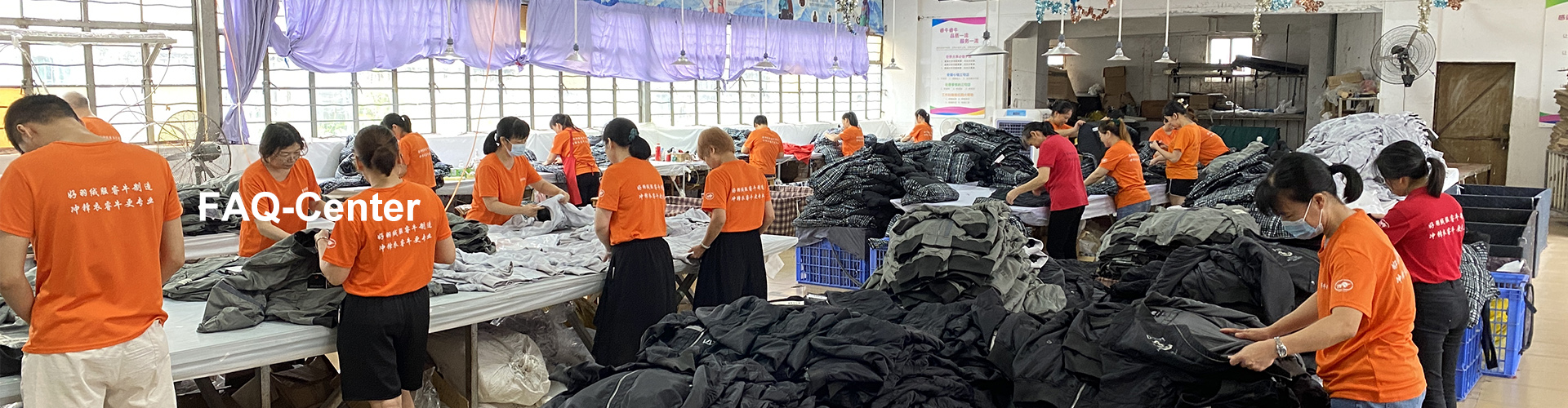
What's on the production floor in Foshan, Guangdong:
Hot-air seam-sealing machines — in-house, not contracted to a third party.
Hydrostatic pressure testing equipment — standard QC step on every waterproof production run, not an optional add-on.
Precision laser cutting systems.
Automated down filling lines.
Dedicated QC inspection lines separate from the production floor.
An in-house sample room with pattern makers who have been developing technical outerwear for over two decades.
The numbers that matter for sourcing decisions:
MOQ from 100 pieces per style — real, not a bait-and-switch number that becomes 500 once sampling starts.
Sampling in 7–10 business days from a complete tech pack.
Bulk production lead time of 25–35 days depending on construction complexity.
Monthly capacity above 50,000 units — which means Ruiniu can scale alongside a brand without requiring a factory switch at growth inflection points.
Verified brand partnerships:
Helly Hansen — Custom kids outdoor rain jackets meeting HH's full waterproof and windproof performance specification. Child-scale seam sealing is technically more demanding than adult sizing, with tighter tolerance requirements on seam tape application.
Swix Norway — Custom ski suits and down jackets for the Nordic sports brand. Swix has been producing ski equipment since 1946. Their technical standards for alpine-use construction are not negotiable, and their QC process is thorough.
Subaru Rally Team China — Custom team jackets with multi-sponsor heat-transfer logo placement on waterproof shell fabric. The technical challenge is maintaining membrane integrity under heat application — a step many factories get wrong, resulting in delamination at the logo edges. Ruiniu's team engineered the application sequence to preserve waterproof performance across all logo placements.
P&G Corporate Program — Bulk down jackets for P&G's enterprise uniform supply program, meeting strict branding consistency requirements across thousands of units on a compressed delivery timeline.
What Ruiniu is not the right fit for: Enterprise brands requiring multi-country manufacturing redundancy or placing above 30,000 units per month across multiple SKUs should look at Youngone or Luenthai. Ruiniu is a specialist technical outerwear factory, not a manufacturing conglomerate.
Most sourcing guides avoid this topic. Sourcing managers shouldn't have to.
The following FOB price ranges reflect technical outerwear OEM production in Guangdong, China for orders above 300 pieces per style in 2026. Below 300 pieces, expect a 15–25% unit cost premium due to setup and changeover costs.
| Product Type | FOB Price Range | Key Cost Drivers |
|---|---|---|
| Basic windbreaker (no seam sealing) | $12–$22 | Fabric weight, print complexity |
| Seam-sealed waterproof jacket | $28–$55 | Membrane rating, seam sealing labor |
| Insulated down jacket | $35–$75 | Fill power, down weight, construction |
| Ski suit (full technical spec) | $55–$120 | Construction complexity, compliance testing |
| Softshell jacket | $22–$45 | Fabric grade, bonding method |
If a factory quotes you significantly below these ranges while claiming full technical specification, ask to see their seam-sealing machine. You probably won't see one.
Prices above do not include third-party testing, international shipping, import duties, or retail compliance certification.
Rarely, in practice.
Large multinational factories — Youngone, Luenthai, Crystal — are structured around high-volume seasonal production for established brands. Their minimum order quantities, development calendars, and account onboarding processes reflect the needs of clients ordering tens of thousands of units per season.
A startup ordering 200–500 pieces per style will typically receive a polite response followed by silence, or will be quoted a minimum that doesn't match their business stage.
Specialized technical factories with genuine low-MOQ capability are the practical option for startup outdoor brands. The key is verifying that low MOQ doesn't mean lower technical standards — which requires the seam-sealing and QC verification steps described in this guide.
This is one of the most common sourcing conversations in the industry, and the reasons are consistent.
Communication breakdown at scale. Large factories manage dozens of accounts simultaneously. Growing brands with smaller order volumes often find themselves handed to junior account managers, with slower response times and less direct access to the technical team.
MOQ becomes a constraint, not an advantage. As brands iterate their product range — adding new categories, testing colorways, developing technical improvements — high MOQ requirements make fast iteration expensive. A factory that requires 1,000 pieces per style to justify production isn't compatible with a brand that wants to test a new jacket construction in two colorways before committing to bulk.
Sampling doesn't match the brand's development pace. Large factory development cycles are built around fixed seasonal windows. Brands developing product year-round or launching outside traditional seasonal calendars often find large factories unable to accommodate their timeline.
Technical problems get deprioritized. When a waterproof seam fails on a 500-piece order from a growing brand, it's a critical issue for that brand and a minor line item for a factory processing millions of units a month.
For technical outerwear specifically — waterproof jackets, ski suits, seam-sealed shells, down jackets — China's Guangdong manufacturing cluster remains the strongest option available in 2026.
The reasons are structural. Technical outerwear requires a supply chain that puts specialized waterproof membrane fabric, seam-sealing tape, technical zipper components, certified insulation, and experienced construction workers within close proximity of each other. That combination exists at scale in Guangdong in a way that Vietnam and Bangladesh have not yet replicated for technical categories.
Vietnam offers competitive pricing for simpler constructions — basic windbreakers, softshells without complex bonding — and is worth evaluating for brands with standardized tech packs and high volume in those categories.
Bangladesh remains strong for commercial workwear and high-visibility outerwear at scale, but the technical outerwear infrastructure for performance outdoor is limited compared to Guangdong.
For brands sourcing genuine technical outdoor apparel — seam-sealed, membrane-laminated, hydrostatic-tested — China is still the realistic answer in 2026.
Three steps. None of them require leaving your desk.
Step one — Live video call on the production floor. Not the showroom. Not a pre-recorded factory tour video. A live call where you can ask them to walk to the seam-sealing machine and show it operating. Factories with genuine waterproof construction capability can do this within 24 hours.
Step two — Request a hydrostatic pressure test report. Ask for a test report from a recent production run showing the waterproof rating achieved — 10,000mm, 20,000mm — with the test equipment visible in the documentation. In-house testing means the factory runs this as a standard QC step. If they need to send fabric to a third party to get you this number, their in-house QC capability is limited.
Step three — Independent pre-shipment sample testing. Before approving bulk production, have a finished pre-production sample independently tested by SGS, Bureau Veritas, or Intertek for the specific performance ratings relevant to your product. Any factory that resists this step is telling you something important.
Choosing based on the sample, not the production line.
A factory's sample room is a separate operation from production — better staffed, more carefully managed, with experienced operators who treat the development sample as a showcase piece.
Bulk production happens on a different floor under different conditions. The most common quality complaint in the industry — across all price points and factory sizes — is bulk production that doesn't match the approved sample.
The brands that consistently avoid this problem have one practice in common: they request a pre-production sample made from actual bulk fabrics before approving the production run. This step adds a week to the timeline and catches the majority of production inconsistencies before they become a container-load of rejects.
Use this on every factory call or visit before committing to a production order.
Seam-sealing machine visible and operating on production floor (live, not recorded)
In-house hydrostatic pressure testing equipment — request a test demonstration
Laser or precision cutting systems for technical pattern pieces
Dedicated sample room with in-house pattern makers
Down filling line if relevant to your product category
Written AQL inspection reports available from the last three production runs
Pre-production sample protocol uses actual bulk fabrics
Third-party inspection accepted: SGS, Bureau Veritas, Intertek
Defect tracking documentation available per production run
Fabric warehouse on-site with certification documentation
OEKO-TEX, GRS, or BLUESIGN available if required by your retail partners
Country-of-origin documentation for customs compliance
Compliance with target market standards (ANSI/ISEA 107, EN ISO 20471, EN 343 as applicable)
Factory registration documents provided (not just a business card)
Live production floor video — not a showroom
References from at least two international brand clients
Export documentation samples from recent shipments
A manufacturer owns and operates the production facility. A trading company is an intermediary — they take your order and subcontract production to factories they may not control directly. Trading companies typically add a margin on top of the factory price and have less direct influence over quality, lead times, and technical decisions. For technical outerwear where construction quality is critical, working directly with the factory is almost always better. Verify by requesting factory registration documents and a live video call on the production floor.
ISO 9001 covers quality management system basics. BSCI or SMETA covers ethical trading compliance. OEKO-TEX Standard 100 covers chemical safety in finished garments — increasingly required by European and North American retailers. For specific product categories: EN ISO 20471 for high-visibility workwear, ANSI/ISEA 107 for the US market, EN 343 for rain protection performance rating. GRS certification covers recycled fabric content for brands with sustainability commitments. Ask for current, valid certificates — expiry dates matter.
Yes, through ODM service. Factories with genuine design capability have in-house pattern makers and design teams who can work from sketches, reference samples, mood boards, or written briefs — developing a tech pack and physical sample without requiring you to supply a finished specification document. If you don't have design capability in-house, look for a factory with an active pattern room, not just a cutting and sewing operation. Ask to speak with the pattern maker directly during your evaluation.
A factory with a dedicated sample room typically delivers a first sample in 7–14 business days from receipt of a complete tech pack. Complex constructions requiring custom fabric development or specialized components may require 15–25 days. Be cautious of factories promising technical outerwear samples in 3–5 days — this usually means they're working from existing patterns and stock fabrics rather than your specification.
At minimum: detailed flat sketches with dimensions, construction notes specifying seam types and finishing, fabric specifications including weight and performance ratings, trims list covering all zippers, cords, buckles, and hardware, colorway specifications with Pantone references, size grading chart, and label and packaging requirements. Incomplete tech packs are the single most common cause of sampling delays and sample-to-spec discrepancies. The more complete your tech pack, the more accurate your first sample will be.
OEM: you supply a complete tech pack, the factory manufactures to your specification. You own the design. ODM: the factory develops the design from your brief or reference sample, you customize with branding and colorways. ODM is common for brands entering a new product category or launching their first collection. OEM is standard once a brand has established design capability and is producing repeat seasonal styles.
Yes. GRS-certified recycled polyester is widely available through Guangdong fabric mills. OEKO-TEX certified fabrics are standard across most technical outerwear factories. BLUESIGN-approved materials are available but require advance sourcing lead time. If sustainability certification is a requirement for your retail partners, confirm the factory can provide material-level documentation — mill certificates and chain-of-custody paperwork — not just a general sustainability statement.
In-process inspection during production catches fabric defects, construction errors, and sizing issues before the full order is complete. Pre-shipment AQL inspection — conducted by a third-party agency against your approved specification — checks a statistically valid sample of finished garments before you authorize shipment. Always require a written inspection report. Verbal quality confirmation from a factory before shipment is not quality control.
The answer depends on your business stage, not on which name is most familiar.
Enterprise brands with annual volumes above 50,000 units per category and established compliance teams typically benefit from multinational supply chains — Youngone and Luenthai are built for exactly that.
Multi-category commercial brands managing diverse product lines at scale are well served by Crystal International's broad manufacturing coverage.
Performance lifestyle brands with volume above 2,000 pieces and standardized tech packs should evaluate Luenthai and Crystal based on their specific category requirements.
Growing outdoor brands — those building technical collections, iterating product development, and scaling from hundreds to thousands of units per style — typically benefit most from manufacturers that combine genuine technical capability with flexible development support and accessible MOQ.
The most important sourcing decision is not which factory has the most impressive client list. It is whether the factory you choose can deliver consistent technical quality at your current order volume — and whether they'll still be solving problems with you six months after the first shipment.
If you're evaluating suppliers for waterproof jackets, softshell jackets, ski suits, or down jackets and would like an independent review of your tech pack or project requirements, our engineering team is happy to provide practical feedback before you place an order.
jacket3@ruiniufashion.com
WhatsApp: +86 189 2865 0351
MOQ from 100 pieces per style. OEM and ODM supported. First sample in 7–10 business days.
How to Verify a Chinese Outdoor Apparel Factory Before Placing an Order
OEM vs ODM: Which Manufacturing Model Is Right for Your Outdoor Brand?
Waterproof Jacket Technical Specifications: A Sourcing Manager's Guide
Custom Outdoor Jacket Manufacturing Cost (2026 FOB Price Benchmarks)
Low MOQ Outdoor Apparel: Realistic Options for Startup and Growing Brands
Guangdong vs Vietnam: Where to Source Technical Outerwear in 2026