


Three years ago, one of our European clients sent us a panicked email in October. Their upcoming spring collection — a line of waterproof hiking jackets already in production — had just been flagged by their retail partner. The problem wasn't the stitching or the fit. It was the DWR coating. The retailer had quietly updated their chemical compliance requirements, and the fluorinated finish our client had been using for years was now on the restricted list.
We'd seen this coming. But that email made it real.
Since then, demand for a reliable PFAS-free jacket manufacturer has moved from a niche concern to something every serious outerwear brand needs to sort out before placing an order. If you're sourcing PFC-free waterproof jackets from China for the EU or US market and you haven't asked your supplier about this yet, this article will tell you exactly what you need to know.
PFAS stands for per- and polyfluoroalkyl substances — a broad family of synthetic chemicals used in everything from non-stick cookware to waterproof textiles for decades. In outdoor apparel, they've historically been the backbone of DWR (Durable Water Repellency) treatments, because they work. Water beads off. Mud doesn't stick. Performance holds up wash after wash.
The problem is what happens after the jacket leaves the consumer's hands. PFAS do not break down in the environment. They accumulate in water systems, in soil, in human tissue. Researchers have linked prolonged PFAS exposure to a range of health concerns, and regulators in Europe and North America have been tightening restrictions steadily over the past decade.
The EU's REACH regulation has already restricted certain PFAS categories, and the trajectory is clear: broader restrictions are coming. Several US states including California, Maine, and New York have passed or are implementing their own PFAS legislation covering textiles. Retailers like Patagonia, Fjällräven, and VAUDE committed years ago to phasing out fluorinated DWR entirely, and larger mainstream brands have followed.
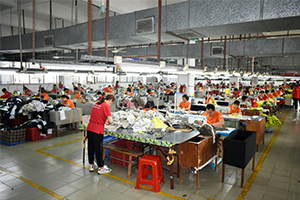
For a Guangdong jacket factory like ours, this is not abstract policy. It is a production question we deal with on real orders, every season.
Before getting into the alternative technologies, it helps to understand what DWR does mechanically.
A DWR treatment is applied to the outer face fabric of a jacket usually during the finishing stage and creates a microscopic surface texture that causes water droplets to bead up and roll off rather than soaking into the textile. Think of it like a field of tiny pillars at the fibre level: water sits on the tips of those pillars rather than sinking between them.
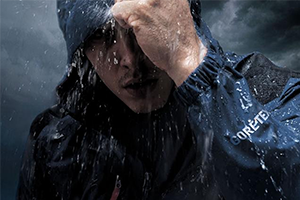
Traditional fluorinated DWR (C8 and, more recently, C6 chemistry) achieves this with long molecular chains that repel both water and oil effectively. The challenge with non-fluorinated alternatives is replicating that performance without the chemistry that causes environmental persistence.
The good news is the technology has genuinely caught up. Fluorine-free DWR chemistries have improved significantly — we've been testing and iterating with our fabric suppliers for the past two years, and the performance gap has closed considerably. For most mid-range and outdoor lifestyle applications, a well-applied fluorine-free DWR now meets or exceeds what C6 offered five years ago.
Where you still see meaningful differences is in extreme conditions — sustained heavy rain, extended use without washing, very high abrasion scenarios. For technical alpine equipment in those conditions, the conversation is more nuanced. But for the majority of DWR coating OEM work we handle — urban commuter shells, hiking jackets, branded outdoor apparel — fluorine-free performs well.
When a brand asks us to produce REACH compliant outerwear, here's what that actually involves across every stage of production:
Fabric selection. We source our waterproof face fabrics from mills that supply documented fluorine-free DWR-treated materials. We ask for test reports, not just declarations. The face fabric is where most of the fluorinated chemistry has historically lived, so this is the most critical point of control for any PFAS-free jacket manufacturer worth working with.
Membrane layers. Most waterproof jackets use a laminated membrane either bonded to the face fabric (2.5-layer or 3-layer construction) or hanging separately inside (2-layer with a drop liner). We work with suppliers offering PFAS-free membrane options, available from multiple mills and proven at our production price range.
Seam tape. The seam tape used in fully-seam-sealed jackets is another chemical input point that is easy to overlook. We specify tape from suppliers with documented non-fluorinated adhesive chemistry.
Testing. Before bulk production, we run water column tests (hydrostatic head) on the fabric to confirm waterproofing meets spec typically 10,000mm or above for hiking jackets, 20,000mm+ for technical shells. After garment construction, we conduct spray tests per AATCC 22 on finished samples. These results go into the quality documentation we provide to every client.
Documentation. For EU-market clients who need REACH compliance paperwork, our OEKO-TEX STANDARD 100 certification means every component — fabric, thread, tape, and trims — has already been tested against a comprehensive restricted substances list. This significantly simplifies the compliance documentation your retail buyers will ask for.
If you're selling REACH compliant outerwear into Europe, the standards your buyers and retailers will ask about include:
REACH Regulation (EU). Restricts specific PFAS categories in articles placed on the EU market. Compliance documentation should trace back to your material suppliers, not just the assembly factory.
OEKO-TEX STANDARD 100. Tests textiles for harmful substances including restricted fluorochemicals. As a certified factory, we can support clients who need OEKO-TEX documentation at the finished garment level. The entire supply chain — fabric, thread, trim — needs to be certified, and we manage that chain actively.
bluesign System. A supply chain standard that restricts harmful chemical inputs at the manufacturing stage, including PFAS. Not all our production runs through bluesign-certified mills, but we can source from them for clients who need it.
GRS (Global Recycled Standard). Relevant if you're combining PFAS-free production with recycled polyester content — an increasingly common request from brands positioning on sustainability.
For US-market clients, state-level legislation is fragmented but converging fast. California, Maine, and New York are the leading indicators. The most common trigger point for brands is not federal law — it's retailer requirements. Ask your retail partners what their current chemical policy is before finalising your fabric spec.
As a PFC-free waterproof jacket manufacturer in China, we work with brands in two situations. Either they have an existing jacket line they need to transition to fluorine-free production, or they're developing something new and want to build compliance in from the start.
For transitions, the process starts with reviewing the existing tech pack and identifying where fluorinated chemistry was specified. We propose equivalent non-fluorinated alternatives, run lab samples, and confirm performance before moving to bulk. Depending on fabric lead times, this adds two to four weeks to the development timeline — but it's a one-time investment that future-proofs the line against tightening regulation.
For new development, we ask about the end market, performance requirements, and retail or certification requirements upfront, and factor the appropriate chemistry into the fabric specification from day one.
MOQ for waterproof jacket production at our Guangdong jacket factory is 300 pieces per style per colour. Sample lead time is typically 20–25 days. We're happy to discuss specifics once we have a tech pack or a brief.
That client from the panicked October email got through it. We transitioned their line in time for the spring delivery. They've since moved their full waterproof range to PFAS-free production and made it part of their brand story — it's now one of the things they lead with at trade shows.
There's a version of this where compliance is a box-ticking exercise, and there's a version where it becomes a genuine competitive advantage. We've seen brands handle it both ways. The difference usually comes down to how early they start.
If you're looking for a PFAS-free jacket manufacturer in China and want to understand what compliant production would look like for your specific project, get in touch. We'll walk through the options without any pressure.