
By Iris Jiang, QC at Ruiniu | Last updated October 10, 2026| Last updated October 10, 2026
Before a bulk jacket order ships, agree three things in writing: the AQL level, how defects are classified, and when inspections happen. Most apparel buyers use General Inspection Level II with 0 critical, 2.5 major and 4.0 minor. AQL does not promise zero defects. It sets how many defects you will accept in a random sample before the whole lot is rejected.
This guide explains how AQL works for outerwear, which defects show up most often in jackets, how each one is found, and how to write inspection terms into your purchase order.
AQL stands for Acceptable Quality Limit. It is the worst average defect rate a buyer is willing to accept across a production lot. Inspectors do not check every jacket. They pull a random sample from the finished goods, count the defects, and compare the count with an accept or reject number from a sampling table (ISO 2859-1, also published as ANSI/ASQ Z1.4).
Three points buyers often miss:
A passed lot can still contain defective jackets. AQL controls the average, not each piece.
A stricter AQL means a larger chance of rejection and usually a higher unit price, because the factory needs more checking and rework.
The AQL must be written into the contract or purchase order. If it is not, there is no agreed standard to enforce.
Every defect is placed in one of three classes. Agree the definitions before production starts, not after a dispute.
| Class | Meaning | Jacket examples | Typical AQL |
|---|---|---|---|
| Critical | Unsafe for the wearer or breaks a legal requirement | Broken needle fragments left inside the garment, sharp hardware edges, missing mandatory safety or labeling information | 0 (none accepted) |
| Major | Makes the jacket unsellable, unusable, or clearly below spec | Open seam, skipped stitches at a stress point, zipper that does not run, peeling seam tape, wrong size label, visible shade difference between panels, holes | 2.5 |
| Minor | Small flaw that does not affect function and most buyers would still accept | Loose thread ends, slightly uneven stitching, light wrinkles, small removable marks | 4.0 |
Some brands tighten the limits (for example 1.5 major and 2.5 minor). Others use looser limits on low-price programs. Use the numbers in your own contract.
With General Inspection Level II, the sample size depends on the lot size. The table below shows common lot sizes at AQL 2.5 (major) and 4.0 (minor).
| Lot size | Sample size | Major (AQL 2.5) accept / reject | Minor (AQL 4.0) accept / reject |
|---|---|---|---|
| 281 to 500 | 50 | 3 / 4 | 5 / 6 |
| 501 to 1,200 | 80 | 5 / 6 | 7 / 8 |
| 1,201 to 3,200 | 125 | 7 / 8 | 10 / 11 |
| 3,201 to 10,000 | 200 | 10 / 11 | 14 / 15 |
Worked example: An order of 1,000 jackets falls in the 501 to 1,200 range. The inspector checks 80 jackets. If the inspector finds 5 or fewer major defects and 7 or fewer minor defects, and no critical defects, the lot passes. With 6 major defects, or any critical defect, the lot fails.
Please confirm these figures against the current ISO 2859-1 table and the inspection standard named in your contract, because buyers sometimes specify a different inspection level.
| Area | Common defects | How they are found |
|---|---|---|
| Seams and stitching | Skipped stitches, open seams, puckering, uneven stitch density, broken thread | Visual check on both sides, gentle pull on stress points (shoulder, armhole, pocket corners) |
| Seam tape (waterproof styles) | Tape lifting at edges, air bubbles, gaps at corners, tape off-center over the seam | Visual check under good light, pull test at corners, water spray on sample pieces |
| Zippers | Not running smoothly, teeth missing, top and bottom misaligned, pull detached, color mismatch | Full-length open and close several times on every inspected piece |
| Fabric and coating | Shade difference between panels, holes, slubs, flaking coating, stains | Compare panels under standard light against the approved sample |
| Insulation | Cold spots, clumping, uneven fill, feathers or fibers poking through the shell | Hand check across baffles, visual check at seams, weight check on sampled pieces |
| Measurements | Out of tolerance at chest, length, sleeve or shoulder | Measure key points on sampled pieces and compare with the tech pack tolerance |
| Trims and hardware | Loose snaps, weak Velcro, broken drawcord stoppers, wrong logo placement | Function test and placement check against the approved sample |
| Labels and packing | Wrong size or care label, wrong barcode, missing required warnings, damaged polybag | Check against the PO and packing list, carton check |
After production, garments should also pass a metal or needle detector. Combined with a visual check for loose hardware, this covers the main critical risks for outerwear.
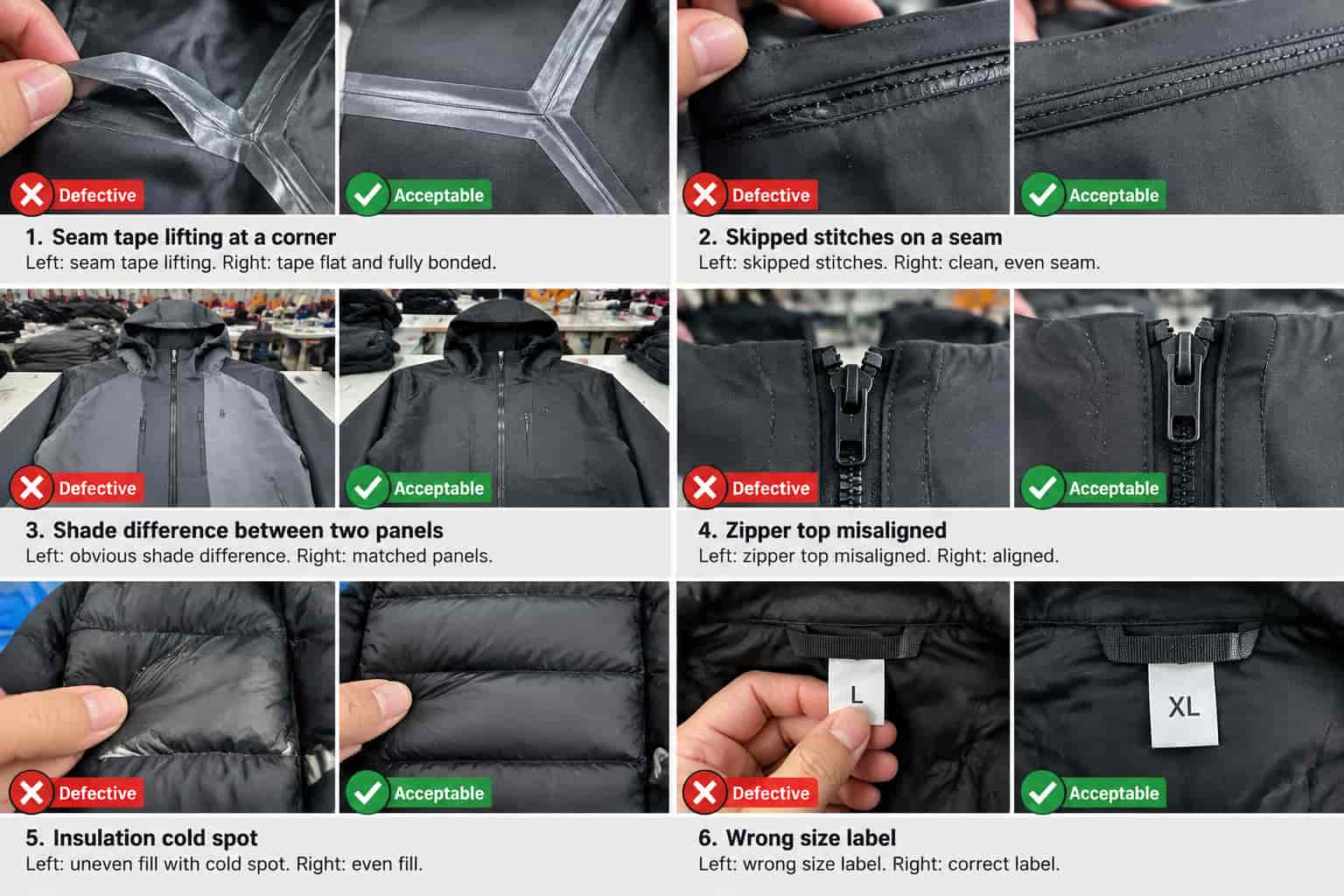
Seam tape lifting at a corner vs tape flat and fully bonded
Skipped stitches on a seam vs a clean, even seam
Shade difference between two panels vs matched panels
Zipper top misaligned vs aligned
Insulation cold spot vs even fill
Wrong size label vs correct label
Real photos with captions are the part of this article other sites cannot copy, so avoid stock images.
A single check at the end is often too late. Rework after packing is expensive and delays shipping. A complete program has four checkpoints.
Pre-production check. Confirm that fabric, trims and hardware match the approved sample, and that the factory has the signed-off tech pack and a sealed reference sample.
Inline inspection. Carried out when roughly 20 to 30 percent of the order is sewn. Problems found here (wrong stitch density, tape alignment, measurement drift) can be corrected before they spread across the whole lot.
Final random inspection. Done when production is complete and most of the goods are packed. A common requirement is 100 percent produced and at least 80 percent packed. The inspector draws the AQL sample from the cartons, checks workmanship, measurements, function, labels and packing, and records the result.
Loading check (optional). Verifies carton count, shipping marks and condition of the cartons at loading.
Our quality process for bulk orders has six steps, from incoming material to shipment.
Material inspection. Fabric, trims and hardware are checked before they enter production.
Sample approval. The sample is approved before bulk production starts.
Cutting check. Cut pieces are checked before sewing begins.
In-line QC. Quality is checked during sewing by the team leader and the in-line inspector (details below).
Final AQL inspection. Finished jackets are checked by random sampling against the agreed AQL standard.
Shipment. Goods are packed and shipped after inspection.
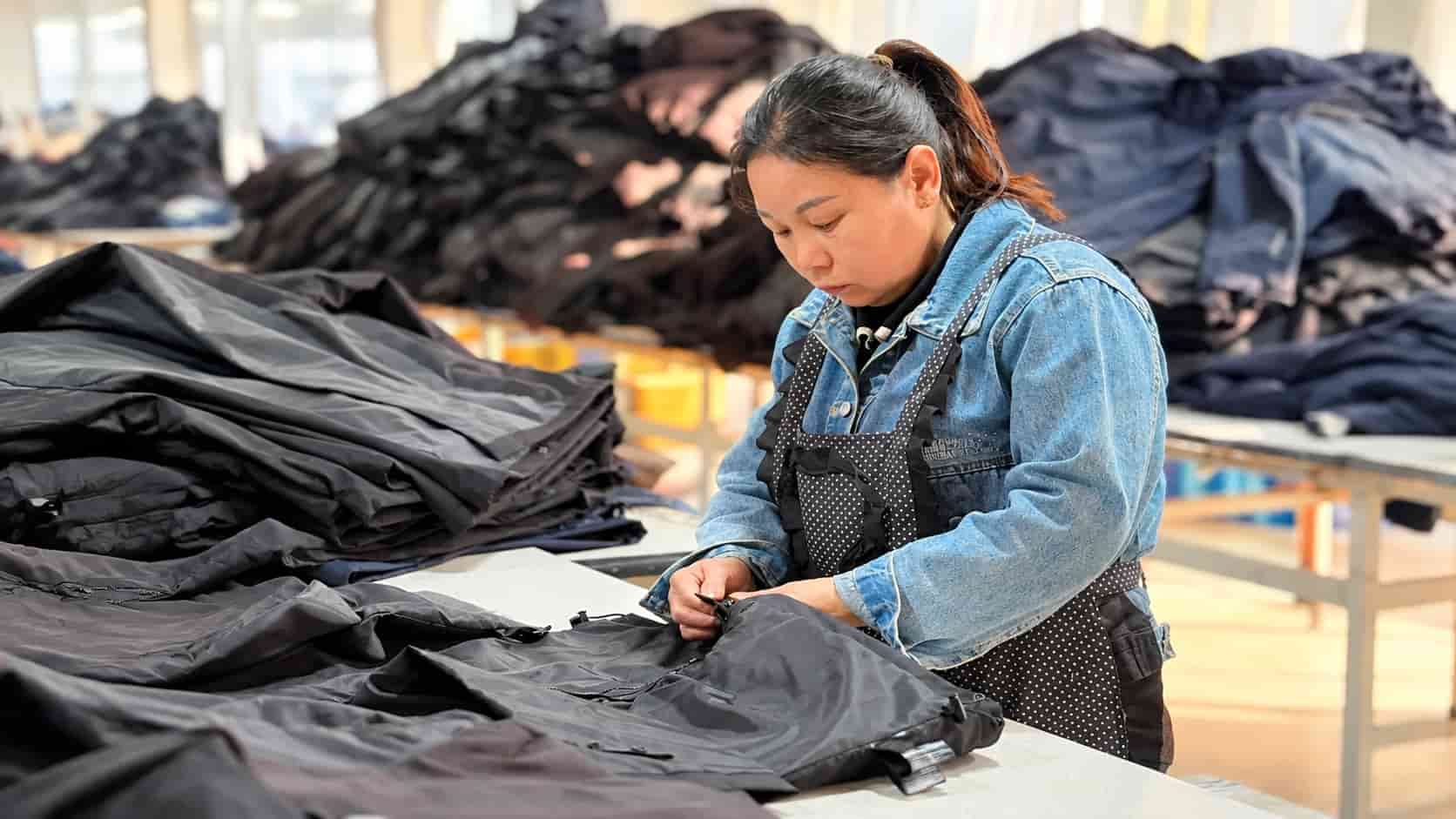
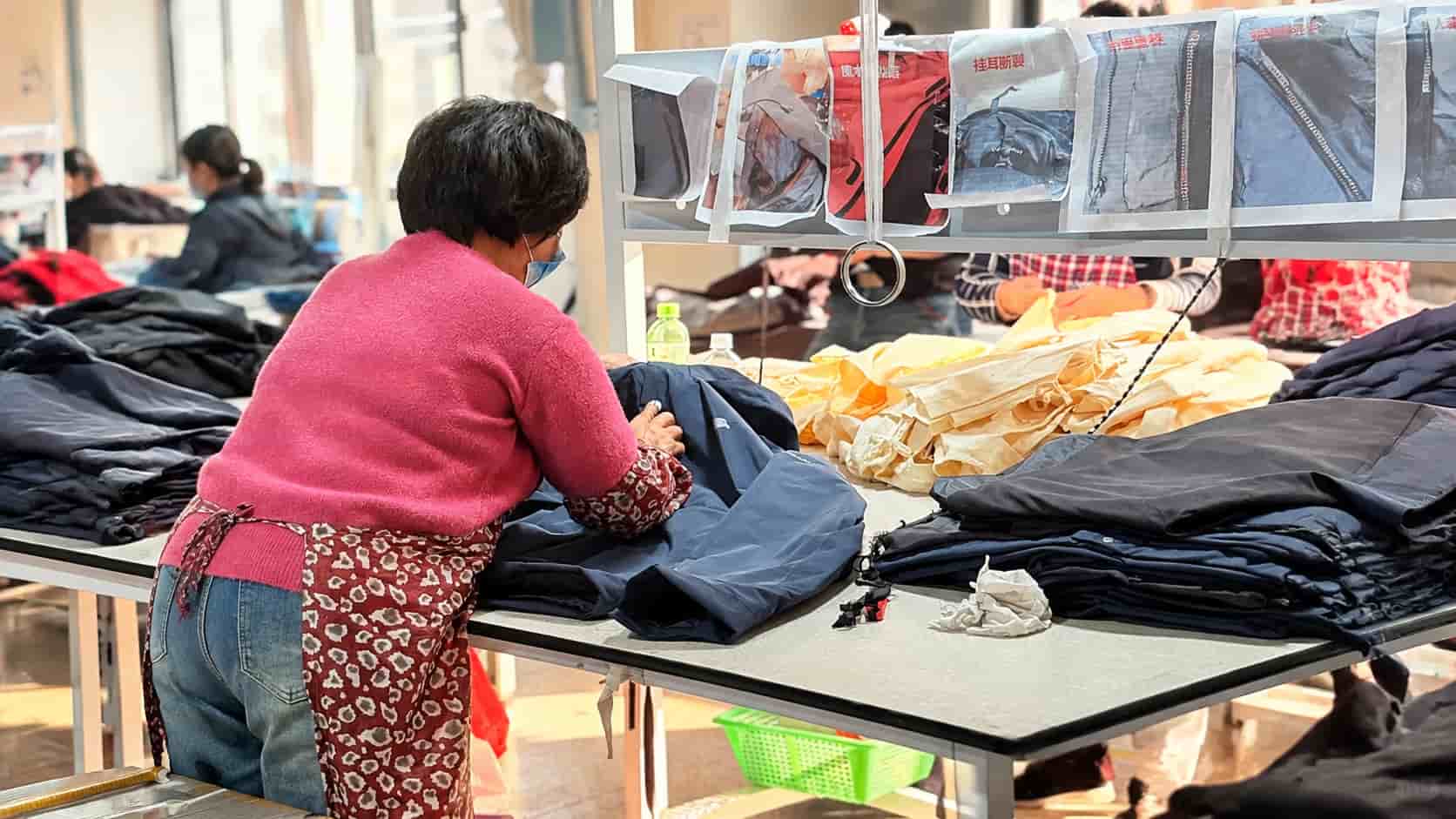
Each production team at Ruiniu has around 20 people, with a team leader and a dedicated in-line inspector. The in-line inspector runs a scheduled round of spot checks about once an hour during production, and the team leader and inspector take turns checking the stitching quality of each sewing worker, so a problem is caught at the machine and not at the end of the line.
When a problem is found, it is handled on the spot, before more pieces are sewn. If a worker is unsure about a construction detail or a quality requirement, they call the team leader right away instead of guessing, so one misunderstanding does not turn into a repeated defect across the lot.
Every check is written on a QC record sheet: how many pieces were inspected and how many had problems. When the whole batch is finished, the records are archived with that batch and kept for at least 2 years.
What this means for a buyer:
Sewing defects are found while the jackets are being made, with scheduled spot checks, not after packing, when rework is slower and more expensive.
Questions on the line are answered by the team leader immediately, so the same mistake is not sewn into hundreds of pieces.
Each batch has a written record of how many pieces were checked and how many problems were found, kept for at least 2 years.
This in-line control works before the final AQL inspection described above: the fewer problems sewn into a lot, the more likely the lot passes.
Approved sample and tech pack on the table for comparison
Fabric color and hand feel match the sample
All seams intact, no skipped stitches at stress points
Seam tape bonded flat with no lifting (waterproof styles)
Zipper runs full length on every inspected piece
Hardware, snaps and drawcords secure
Key measurements within tolerance
Logo, labels and care labels correct and in the right position
No loose thread ends, stains or marks above the agreed limit
Metal or needle detection completed
Polybag, carton marks and packing quantity match the PO
A failed lot is not automatically cancelled. The usual steps are:
The factory sorts 100 percent of the lot and removes or repairs defective pieces.
Repaired goods are inspected again, often with a fresh sample.
Shipping is delayed until the lot passes.
Agree in advance who pays for sorting and re-inspection, and how many re-inspections are allowed. Written terms prevent most disputes.
Include these lines in the PO or quality agreement:
Sampling standard: ISO 2859-1 (or your chosen standard), General Inspection Level II
AQL: 0 critical, 2.5 major, 4.0 minor (or your own limits)
Defect classification list, with photos for borderline cases
Inspection timing: inline and final
Who inspects: the factory QC team, your own inspector, or a third-party company
Report format: inspection report with photos of each defect found
Failure terms: sorting, rework, re-inspection costs and delivery date impact
Third-party inspection companies such as SGS, Intertek, QIMA and Bureau Veritas can carry out the final inspection if you want an independent result.
Many apparel buyers use 0 for critical defects, 2.5 for major and 4.0 for minor, at General Inspection Level II. Brands with higher quality targets use tighter limits.
No. AQL checks a random sample and accepts a defined number of defects. A passed lot can still contain a small number of imperfect pieces within the agreed limit.
When production is finished and most goods are packed, commonly at least 80 percent packed, so the sample can be drawn from the actual cartons.
It depends on the contract. Factory in-house QC is normally part of production cost. Third-party inspections are usually paid by the buyer unless agreed otherwise.
The factory sorts and repairs the lot, then the goods are inspected again. Agree these steps and costs before production starts.
Contact us with your style, target quantity and quality requirements, and we will tell you which inspection plan fits your order. Get your OEM quote.