

Updated November 17, 2026
How OEM buyers should compare coating, membrane, hand feel, breathability, durability and testing before bulk production.
Quick answer
PU is usually the practical starting point for a waterproof outdoor jacket because it offers a useful balance of flexibility, hand feel and cost. PVC is mainly suited to products where total water blocking and a lower material cost matter more than breathability or drape. TPU is normally supplied as a membrane or laminated film; it fits performance programs when flexibility, abrasion resistance and controlled lamination justify the extra process work. The chemistry alone does not make a jacket waterproof. The face fabric, coating route, seam construction and test method all matter.
Coating and membrane are not the same thing
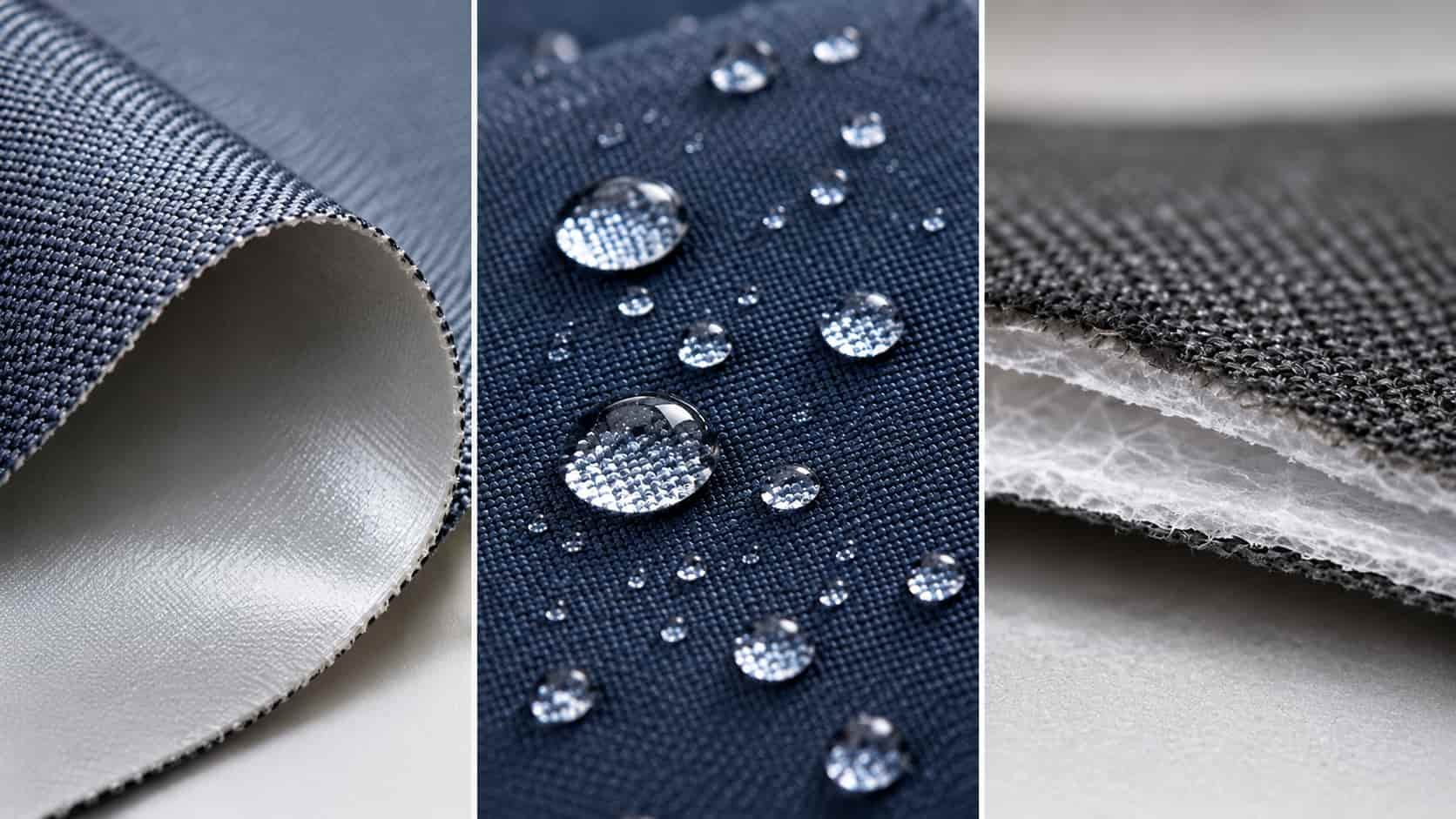
A coating is a polymer applied directly to the back of a textile and then dried or cured. A membrane is a pre-made film bonded to the textile by lamination. PU and PVC may be used as coatings or films, while TPU is commonly discussed as a membrane or laminated film in technical outerwear. Put the route in the tech pack. “Waterproof fabric” is not a specification that three suppliers can quote consistently.
Water management in a finished jacket has several layers: the face fabric handles abrasion and tear strength, DWR helps rain bead on the surface, the coating or membrane blocks liquid water, and seam tape or welding closes needle holes. A leak blamed on the polymer may actually come from an unsealed seam, a wetting-out face fabric or a water-trapping zipper.
PU vs PVC vs TPU for jacket sourcing
| Material route | Where it can fit | What to watch | Approve before bulk |
|---|---|---|---|
| PU coating | Urban rainwear, lightweight shells, softshells and fashion outerwear | Coating route, add-on consistency, adhesion, hydrolysis and wash durability | Hydrostatic pressure, water-vapour resistance, adhesion after washing and flex |
| PVC coating or film | Rainwear, workwear, rain trousers, bags and products where wipe-clean water blocking is the priority | Weight, stiffness, low-temperature flex, ventilation and plasticizer documentation | Hydrostatic pressure, cold flex, compound declaration and REACH testing |
| TPU membrane or laminate | Performance shells, flexible technical jackets and selected premium constructions | Film grade, lamination adhesive, peel strength, welding settings and material minimums | Hydrostatic pressure, water-vapour resistance, peel strength and low-temperature flex |
PU coating: the practical starting point
PU is often the first route to review for an outdoor jacket because it can be made soft, quiet and compatible with nylon or polyester. The important question is not simply “Is it PU?” Ask whether it is a direct coating, transfer coating or laminated PU film, and ask how the supplier controls coating weight and curing.
The main risks are not identical for every formulation. Standard PU can be vulnerable to hydrolysis in hot, humid storage, while poor surface preparation can cause adhesion failure. A sample that passes a day-one water test is not enough. If the jacket will be washed, compressed or stored in a humid market, include wash-conditioned adhesion and ageing checks in the approval plan.
PVC: useful for the right product, not a universal jacket solution
PVC can provide strong water blocking and can make sense for rainwear, workwear or products that need a robust wipe-clean surface. The same properties can make a jacket heavy, stiff and uncomfortable during active use. A non-porous PVC structure should not be presented as breathable without a specific design and test result.
For EU-bound products, request the exact compound information and current test reports. Certain phthalates are restricted under REACH, so a generic statement such as “PVC compliant” is not a sufficient production document. Confirm the compound, the finished article and the market requirements before sampling.
TPU: a membrane and lamination decision
TPU is commonly supplied as a film bonded to the face fabric or lining. It can offer a soft, flexible hand and is attractive when a brand needs a technical construction rather than a simple back coating. The result depends on the film grade, adhesive system, lamination temperature, pressure and fabric preparation.
Do not approve a TPU program from a flat-film datasheet alone. Check the laminated fabric and then check the finished garment. Peel strength, seam construction and low-temperature flex are part of the product, not optional extras. Some RUINIU softshell constructions use a TPU membrane with PUR point bonding; the exact route must still be confirmed for the individual fabric and order.
Tests to request before bulk production
Use the test method and the test condition in the specification. ISO 811:2018 covers resistance to water penetration by hydrostatic pressure. ISO 11092:2026 covers thermal resistance and water-vapour resistance for textiles, films and coatings; report water-vapour resistance as Ret, in m²·Pa/W, unless another method and unit are stated.
Hydrostatic pressure on the actual fabric construction, not a substitute.
Water-vapour resistance with the stated method, conditioning and unit.
Coating adhesion or laminate peel strength before and after washing.
Flex fatigue and low-temperature bending for the intended climate.
Hydrolysis or ageing checks when PU or TPU will be stored hot and damp.
Seam-seal or welding checks on a finished sample jacket.
REACH, PFAS and other restricted-substance documents for the actual material.
What to put in the RFQ
Write the material route instead of only the polymer name. Include the face-fabric fiber and weight, coating or film type, direct coating or lamination route, target hydrostatic pressure, water-vapour test method, wash expectation, seam-sealing method, color, order quantity and compliance market. Ask the supplier to identify the material certificate holder and the scope of every document.
At RUINIU, incoming materials undergo 100% inspection across 24 inspection points. Final inspection uses AQL 2.5 for major defects and AQL 4.0 for minor defects. Production samples can be tested in the internal laboratory for items such as hydrostatic pressure and seam strength; the required test plan depends on the approved product specification. Read our quality-control process.
Related waterproof guides
This guide focuses on choosing the polymer route. For rating definitions, see our 10K vs 20K vs 30K waterproof fabric guide. For production construction, see the waterproof jacket manufacturing and seam-sealing guide. For fluorine-free finishing and documentation, use the PFAS-free DWR guide after confirming its current canonical URL.
Frequently asked questions
Is PU better than PVC for a waterproof outdoor jacket?
Not automatically. PU is usually easier to balance with flexibility and breathability. PVC can be the better choice for heavy-duty water blocking or wipe-clean products. The correct answer depends on the end use, climate, hand-feel target and compliance requirements.
Is TPU a coating?
TPU can be used in different forms, but in technical jackets it is commonly supplied as a membrane or film laminated to the textile. The RFQ should state whether the supplier is quoting a direct coating, a film or a laminate.
Does a high hydrostatic result prove the jacket is waterproof?
No. Hydrostatic pressure is a fabric or material result. Needle holes, zippers, hood construction and unsealed seams can still leak on the finished garment.
What should a buyer request before approving a coated fabric?
Request the exact material construction, coating or film route, test method, conditioning, adhesion or peel result, wash result and compliance documents. Then inspect the finished sample at seams and openings.
Need help choosing a coating route?
Send RUINIU your tech pack, target market, jacket use case and quantity. We can review whether a PU coating, PVC construction or TPU laminate fits the required hand feel, testing plan and production route.