
By Iris Jiang, Outdoor Apparel QC and OEM Content Lead at RUINIU · Updated November 11, 2026
Outdoor clothing customization lets a brand or corporate team define the garment type, materials, fit, branding and quality requirements before sampling. The right program depends on the intended activity, weather exposure, wearer group and sales market.
Quick answer
Start with the use case, then select the product type, fabric, color, fit, branding and inspection requirements. Send the same brief to each supplier so samples and quotations can be compared on one specification. RUINIU generally works with an MOQ of 100 pieces per style per color; the final requirement depends on the selected fabric and customization.

The table below is a starting point for an OEM brief. Each product page contains the detailed construction options and should be used after the buyer has defined the intended use.
| Product type | Suitable program | Confirm before sampling | Product page |
|---|---|---|---|
| Fleece jacket | Corporate layers, casual outdoor ranges and mid-layer programs | Fabric weight, pilling, color, fit and care label | Custom fleece jackets |
| Softshell jacket | Active use, travel, workwear and variable weather | Stretch, lining, water resistance, seam construction and trim | Custom softshell jackets |
| Waterproof jacket | Wet climates, hiking and exposed outdoor use | Membrane or coating, seam sealing, zippers and test method | Custom waterproof jackets |
| Windbreaker | Lightweight travel, lifestyle and promotional outerwear | Shell weight, finish, lining, pocket layout and branding | Custom windbreaker jackets |
| Down or puffer jacket | Cold-weather ranges and insulated corporate programs | Insulation type, fill specification, shell, construction and testing | Custom down jackets |
| Ski suit or ski jacket | Ski, snow and technical winter programs | Layering, snow protection, movement, seam details and safety features | Custom ski suits |
Use and wearer: state the activity, climate, wearer group and expected layering.
Product and fit: provide a reference garment, tech pack, measurement chart or clear fit comments.
Fabric: specify fiber content, weight, finish, lining, stretch and any restricted-substance requirements.
Color: provide a color standard and the quantity by style, color and size.
Branding: confirm logo artwork, labels, badges, hangtags, zipper pulls and packaging marks.
Construction: identify pockets, hood, cuffs, hem, seam treatment and reinforcement points.
Testing and care: list the target market, required tests and the approved care-label wording.
Commercial plan: confirm MOQ, packing method and delivery requirements with the quotation.
A private-label brand normally prioritizes repeatable fit, color control, packaging and a specification that can be reordered. A corporate team may place more emphasis on logo placement, name labels, size allocation, visibility and a consistent appearance across several garment types. Both programs benefit from approving one complete sample before bulk production.
Define the product type, target wearer, intended use and market.
Share the tech pack, reference garment, artwork or measurement chart.
Confirm fabric, color, trims, labels, packaging and required tests.
Review the development sample and record approved changes.
Confirm the pre-production specification before bulk manufacturing.
Check production against the approved sample and agreed quality requirements.
For OEM and ODM support from tech-pack review through production, see our OEM and ODM service.
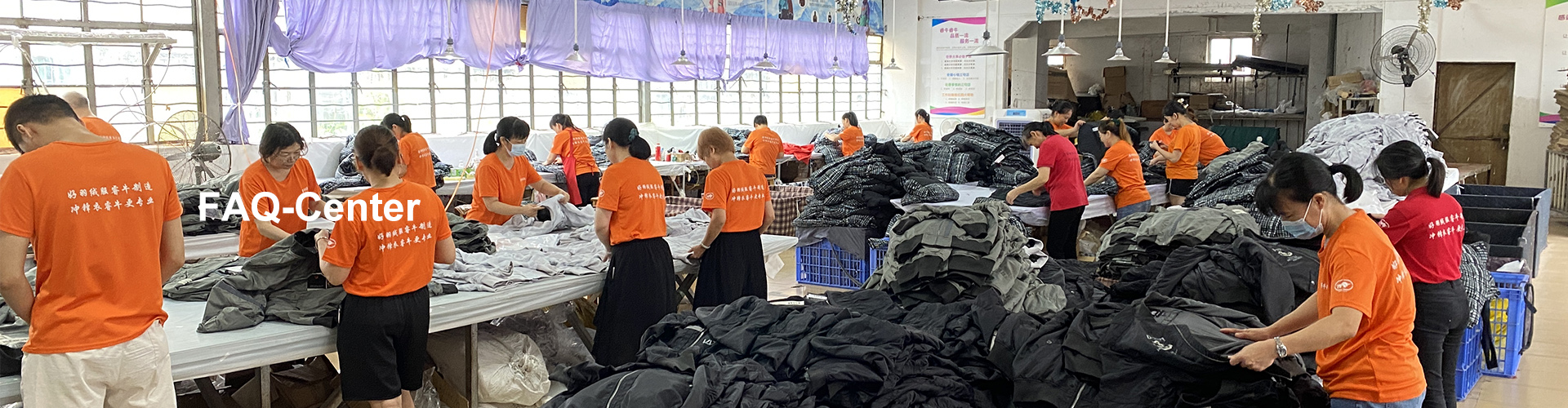
At RUINIU, incoming fabrics receive 100% inspection, production runs through 24 quality-control checkpoints and final inspection follows an AQL 2.5 standard. Randomly selected production samples are tested in the in-house laboratory, batches are traceable through ERP records, and third-party inspection by SGS, TUV or Intertek can be arranged.
These controls do not replace product-specific testing. Buyers should still approve the exact fabric, construction and test plan for the order. The Quality Control page lists the inspection flow and test methods.
A UK customer ordered 3,000 softshell workwear jackets after reporting that an earlier production from another factory developed leaking seams after one or two wears. The earlier production had passed a hand-pull check and a spray test only. After machine washing and rubbing, tape edges lifted and some curved or layered seam areas developed weak points.
For this project, the key lesson was that many softshell designs need seam taping at selected critical positions rather than a generic promise of waterproofing. Stretch fabric, tape hardness, machine temperature, air pressure, running speed and seam allowance thickness must work together. Curved seams, underarm areas and multi-layer joins need particular attention, and a spray test alone is not enough to predict wash durability.
We developed the sample around the required seam treatment, adjusted the taping work for the stretch fabric and had the customer wear-test the approved sample before the order was confirmed. The customer later reported that the finished quality met expectations. This case is why seam construction and wash-related validation should be written into the brief before a supplier is selected.
For the production side of seam sealing, see our seam sealing guide.
A program may include fleece jackets, softshell jackets, waterproof jackets, windbreakers, insulated jackets and ski garments. The final range should follow the intended use and a written specification.
Send the product type, reference images or tech pack, measurements, fabric preferences, color requirements, branding artwork, size allocation, target market and testing requirements.
Yes. Corporate programs can define logos, badges, name labels, color standards, size allocation and packaging requirements across one or several garment types.
Compare relevant samples, fabric documentation, development communication, quality-control procedures and the supplier's ability to reproduce the approved specification. Ask each supplier to quote from the same brief.
Share your product type, target wearer, branding requirements and reference materials with RUINIU for an initial review.