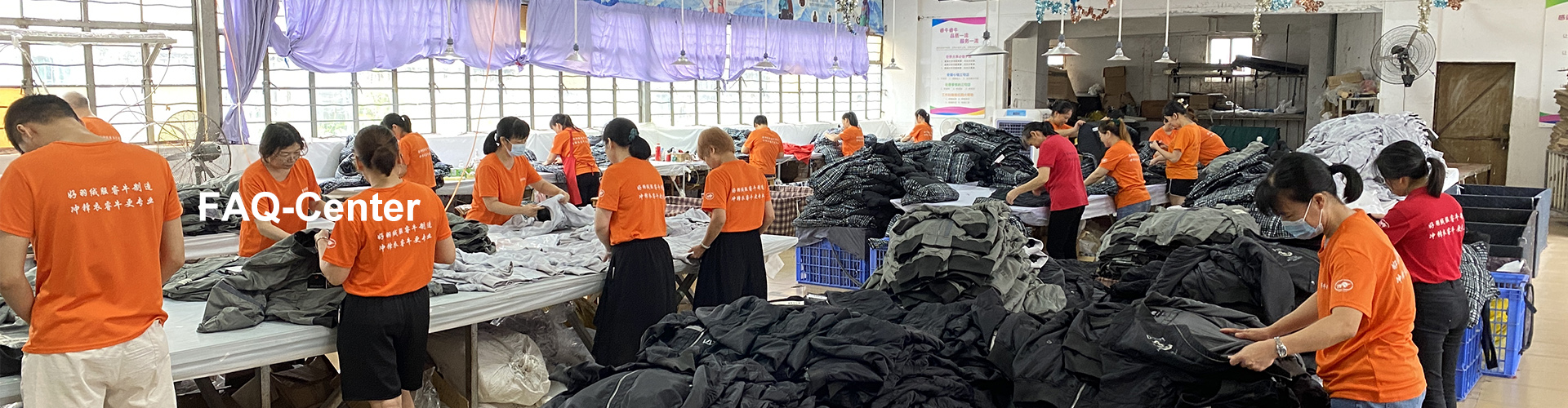

How an Outdoor Jacket Factory Prepares a Sewing Line for Bulk Production
An approved sample doesn't mean a jacket is ready for full-line production. A sample is usually made by one experienced sample maker from start to finish, adjusting the sewing as they go. Bulk production works differently. The jacket is divided into separate operations across a production line, with different workers and machines repeating the same operation throughout the order.
Once production moves from one sample to hundreds or thousands of jackets, a small difference in thread tension, feeding, machine setup or sewing sequence can become a repeated defect. Line preparation is how we turn an approved sample into a production method that can be repeated consistently before bulk sewing begins.
Before arranging the sewing line, the production team needs to know exactly which version of the jacket has been approved.
The production references normally include the approved pre-production sample, tech pack, measurement chart and tolerances, BOM, approved fabrics and trims, logo artwork, and confirmed construction details for pockets, hood, cuffs, seams and other components.
A tech pack says what should be made. The approved sample shows how those specifications were actually translated into a garment.
That distinction matters more the further a style has gone through sampling. By the time something is approved, the pocket opening, zipper length or hood shape may have shifted from what the first tech pack described — sometimes more than once.
So the sewing line works from the final approved production references, not an earlier development version.
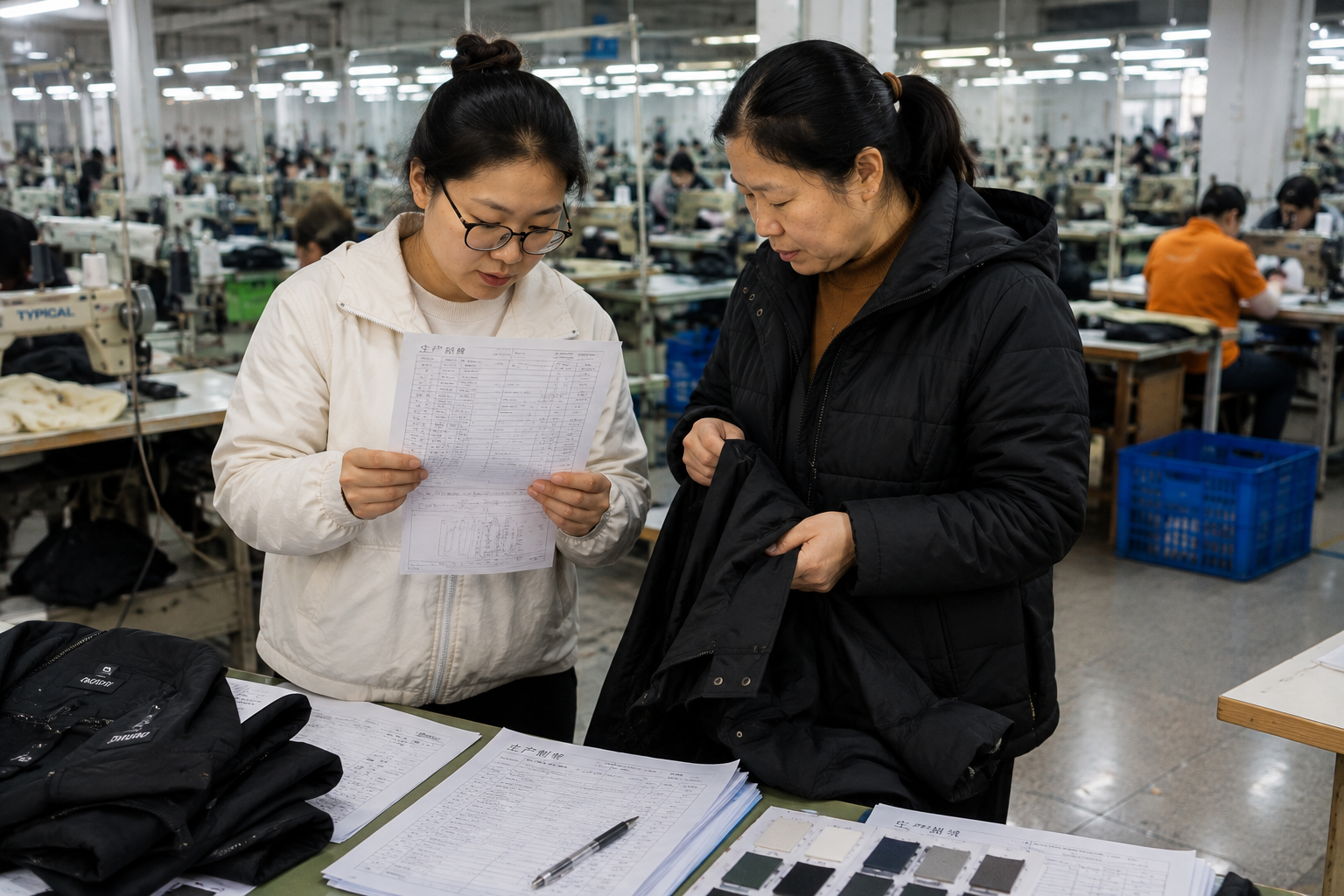
Approved jacket sample together with tech pack, measurement sheet or BOM.
A bulk-production jacket is not normally sewn from start to finish by one operator.
It is broken down into individual operations according to the construction of the garment.
For a typical outdoor jacket, these can include pocket preparation, zipper installation, front panel assembly, hood construction, sleeve and cuff work, shell assembly, lining assembly, shell-to-lining joining, hem finishing and topstitching.
The operation breakdown changes significantly with the product.
A lightweight windbreaker has relatively few layers. A ski jacket may include insulation, lining, several zipper pockets, an adjustable hood, cuffs, a snow skirt and other functional components.
Breaking the garment into operations is not only about production speed. It also tells the production team where specific machines, attachments or more experienced operators are needed before the line begins running.
A difficult zipper operation, for example, should be identified before hundreds of front panels reach that workstation.
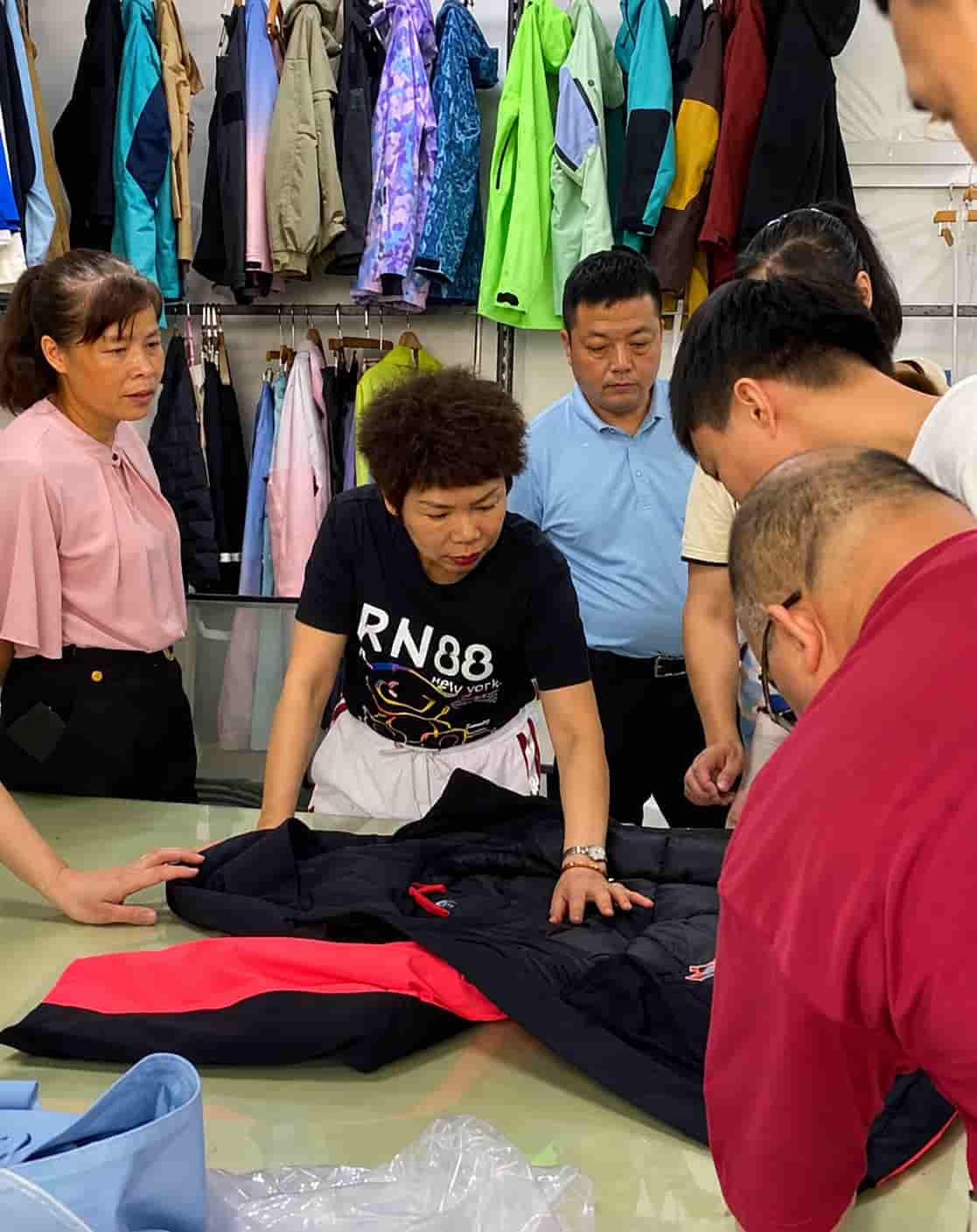
Sewing line preparation or workers assigned to different jacket operations.
We don't use one sewing setup for every windbreaker or outdoor jacket.
Needle size and point type, thread size, tension, presser-foot pressure and stitch length are adjusted according to the actual fabric weight, composition, denier and construction.
Lightweight shell fabrics make this particularly visible. An unsuitable setup can result in seam puckering, visible needle holes, fabric shifting or a wavy zipper edge.
Below are examples of production settings we use for two common lightweight windbreaker fabrics. You can learn more about fabric performance in our 10K vs 20K waterproof fabric guide.
| Fabric | Needle (DPx5 System) | Thread | Face-Side Tension* | Stitch Length |
|---|---|---|---|---|
| 40–60D thin nylon windbreaker | 65/9 (#7), round point | 602/402 | 2.8–3.5 | 2.2–2.6 mm |
| 70–100D regular windbreaker nylon | 70/10 (#9), round point | 402 | 3.0–4.0 | 2.5–3.0 mm |
*Tension figures are the dial settings used on our production machines.
These figures are production settings used for these fabric types in our factory. They are not universal specifications for every 40–100D shell fabric.
The final setup still needs to be confirmed against the actual bulk fabric because weave, coating, surface finish and fabric behavior can affect sewing performance even when two fabrics have a similar denier.
For lightweight nylon taffeta or pongee, we generally work with a smaller round-point needle and a looser tension setting to reduce permanent needle marks and seam puckering.
A heavier polyester fabric or softshell jacket requires a different setup.
The important point is that these parameters are confirmed before normal line production. They are not left for each sewing operator to adjust independently while bulk production is already running
Not every part of a jacket carries the same production risk.
A lightweight shell may sew cleanly along a straight side seam but behave very differently around a zipper or curved opening.
Front zipper installation is one example. A zipper can look straight when laid flat but become wavy after sewing if the zipper tape and shell fabric are not fed consistently.
Pocket openings need close attention to position and left-right symmetry. Hood construction often involves curved, multi-panel seams. Elastic cuffs, adjustable hems and drawcord channels introduce additional components that need consistent placement.
Logo position also has to be confirmed at the correct stage. Once a lining or another panel has closed off access to an area, correcting a misplaced logo can become much more difficult.
These higher-risk operations are identified before normal production so that machine setup, operator assignment and inspection can focus on them from the beginning.
The order in which a jacket is assembled matters.
Some operations become difficult—or impossible—to correct once the next component has been attached.
A logo may need to be applied before the lining closes the panel. A pocket normally needs to be completed before the front panel is fully assembled.
On waterproof and seam-taped jackets, there is another issue: the sewing sequence also affects whether the seam can be taped properly afterward.
We have encountered situations where a seam crossing too close to a pocket zipper created too much bulk for the seam tape to bond evenly.
From the sewing operator's point of view, the construction could still be sewn. From the seam-sealing operator's point of view, however, the same construction made it difficult to achieve consistent tape contact around the bulky intersection.
This is why sewing and seam sealing cannot always be planned as two completely separate processes.
For seam-taped outerwear, we consider how the seam will be accessed and taped later when determining the sewing sequence.
Our standard first-piece check is 3 to 5 complete garments, checked continuously and covering the style's key sizes.
Some buyer programs specify a different approval procedure — for example, one complete garment in every size before bulk production is released. Where that's the case, we follow whichever requirement has been agreed for that order.
Either way, the pieces are checked against the approved pre-production sample, tech pack, measurement specifications and confirmed workmanship requirements.
The review covers points such as:
Garment measurements
Sewing quality
Thread tension and stitch appearance
Zipper installation
Pocket position
Left-right symmetry
Logo and label placement
Construction details
Overall garment appearance
Our QC supervisor and technical team, including the pattern maker and sewing technician, review the initial production pieces together. Once the internal checks pass, the quality manager signs off before the line moves into normal bulk production.
Where buyer approval is required, first-piece photos or physical samples can also be submitted for confirmation before production is released.
What if something changes after approval?
A production change is not simply passed directly to the sewing line.
If an approved construction, material or other confirmed production detail needs to change before or during production, a revised production sample is made for confirmation.
Where buyer approval is required, the revised sample is submitted to the buyer, and bulk production of the changed version starts only after the new sample has been confirmed.
This prevents a production adjustment from becoming an undocumented difference between the approved sample and the finished order.
Approving the initial production pieces confirms that the line started correctly. It does not mean the rest of the order can run without further inspection.
A sewing line can drift during production.
A machine setting drifts, an operator changes, or a new fabric roll simply behaves a little differently from the one before it — the kind of variation that a long production run introduces but that first pieces, made at hour zero, wouldn't show. That's what inline inspection is for: checking garments while production is running, rather than waiting until the order is finished.
What happens when the same defect starts repeating?
If the same defect begins to repeat during bulk production, the affected operation is stopped rather than allowing the line to continue producing the same problem.
The technical and QC teams then investigate the cause. Depending on the issue, this can include checking:
Machine settings
Needle selection
Thread selection
Operator handling
Feeding
Fabric behavior
Construction method
Once the likely cause has been identified, the setup may be adjusted, materials changed where necessary, or the operation retrained before production continues.
Garments produced since the last confirmed good inspection point are fully checked and sorted rather than relying only on spot inspection.
The corrective action is recorded in writing, and the affected operation resumes only after the cause has been corrected and the output has been rechecked.
Where required, a defect or corrective-action report can also be provided to the buyer.
Final inspection comes later
Final inspection serves a different purpose.
Before packing, final inspection follows AQL 2.5 or the buyer's specified inspection standard. The inspection sample is selected according to the order quantity and checked against the applicable major and minor defect criteria.
The three stages answer different questions:
First-Piece approval: Did the production line start correctly?
Inline inspection: Is the line continuing to produce consistently?
Final inspection: Does the finished order meet the agreed inspection standard before packing?
There is no single sewing-line setup that works for every type of outerwear.
| Jacket Type | Typical Production Points to Watch |
|---|---|
| Lightweight Windbreaker | Fabric shifting, seam puckering, zipper waviness, needle marks |
| Softshell Jacket | Fabric stretch, seam bulk, zipper alignment, topstitching |
| Waterproof Shell | Seam construction, waterproof zipper areas, seam-tape compatibility |
| Padded Jacket | Insulation thickness, panel alignment, seam bulk |
| Down Jacket | Down-proof construction, needle holes, filling sections, down migration |
| Ski Jacket | Multi-layer construction, waterproof details, multiple pockets, cuffs and snow skirt |
For example, the setup used for a thin polyester or nylon windbreaker is not the same setup we would use for a heavier softshell.
A seam-taped waterproof shell introduces another set of concerns because the sewing construction has to remain compatible with the later seam-sealing process.
A down jacket adds still more variables around needle holes, down-proof construction and filling sections.
Line preparation follows the actual product, not a generic jacket checklist.
An approved sample proves that a factory can make the product once.
Bulk production asks whether the same product can be reproduced consistently across hundreds or thousands of pieces.
The gap between those two stages is where line preparation matters.
The approved garment has to be translated into individual operations. Machine settings have to match the actual bulk fabric. Difficult sewing points need to be identified before they repeat across the order. Sewing sequence needs to account for later processes such as seam sealing. Initial production pieces need to be approved, and quality control has to continue while the line is running.
For buyers evaluating an outdoor jacket manufacturer, these production controls are often more useful to understand than production capacity alone.
Our standard first-piece check is 3 to 5 complete garments, covering the style's key sizes. Some buyer programs specify a different approval procedure — for example, one complete garment in every size — and we follow whichever requirement has been agreed for that order. Either way, the pieces are checked against the approved sample, measurement specifications and confirmed construction requirements.
The affected operation is stopped and our technical and QC teams investigate the cause. Garments produced since the last confirmed good inspection point are fully checked and sorted. Corrective action is recorded, and the operation resumes only after the cause has been corrected and the output has been rechecked.
No. Settings are matched to the actual fabric weight, composition, denier, construction and behavior. For example, the lightweight windbreaker fabrics shown above use different needle sizes, thread and tension settings. Final parameters are confirmed against the actual bulk fabric before normal line production.
The change is not simply passed directly to bulk production. A revised production sample is made and, where buyer approval is required, submitted for confirmation. Production of the changed version starts only after the revised sample has been approved.
Our QC supervisor and technical team, including the pattern maker and sewing technician, review the initial production pieces against the approved pre-production sample, tech pack, measurement specifications and workmanship requirements. Once the internal checks pass, the quality manager signs off before the line moves into normal bulk production.
Send us your tech pack, reference sample or product images. Our team can review the fabric, construction, sizing, zippers, trims, branding and production requirements before sampling and bulk production.
MOQ and lead times vary by construction and order specifics. Contact RUINIU to review the requirements for your project.