
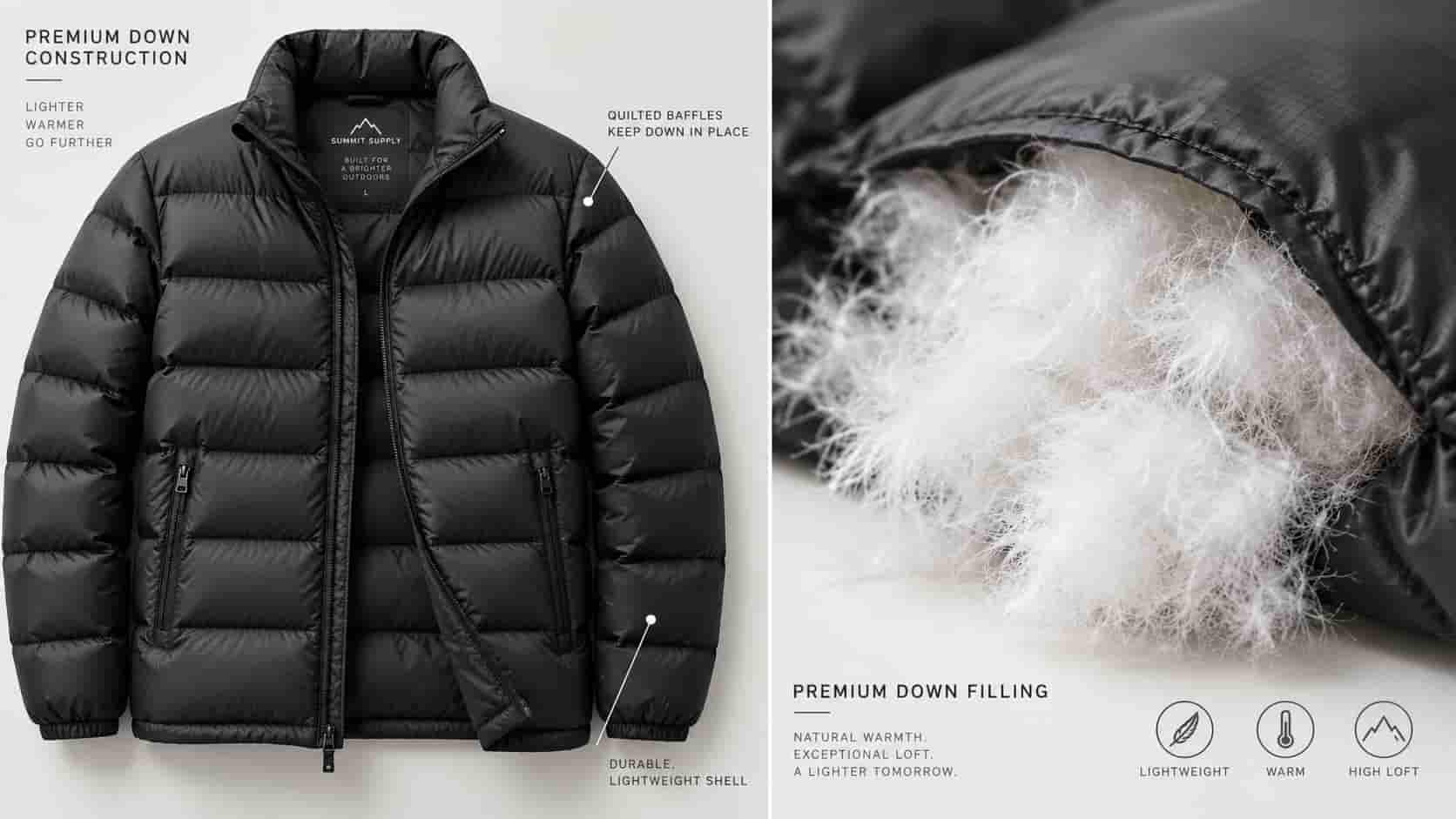
A puffer jacket and a down jacket often get treated as the same thing. They aren't. Puffer describes how a jacket is built — quilted panels, lofted chambers, insulation stitched into sections. Down describes what's inside those chambers: a specific natural fill. A puffer can be filled with down, with synthetic insulation, or a mix of both. Which one makes sense for a collection depends on product positioning, climate conditions and target customer expectations.
Quick Answer
| Term | Refers To | Common Filling |
|---|---|---|
| Puffer Jacket | Quilted garment construction | Down or synthetic |
| Down Jacket | Insulation type | Goose or duck down |
| Synthetic Puffer | Quilted construction | Polyester insulation |
The name comes from how the jacket looks once it's sewn: rows or blocks of insulation stitched between two fabric layers, each chamber puffing out slightly. That's the whole definition — a construction method, not a material spec.
Three things make a jacket read as a puffer: quilted panels or chambers, insulation held in place by stitching, and the rounded, lofted silhouette that results. None of that says anything about what's inside. A brand can put down in that structure, or polyester fiberfill, or a blend of both, and the garment is still a puffer either way.
The "puffer" name comes from the shape the insulation creates, not from the fill material itself.
Down — the fine clusters beneath a goose or duck's outer feathers — traps more warmth per gram than most other insulation available. That's why down remains a common choice in premium outdoor products where low weight and compressibility are priorities: a down jacket can be genuinely warm without feeling heavy, and it compresses down to almost nothing in a pack.
The trade-off shows up in wet conditions. Down clusters lose loft when they get damp, and warmth drops with them until the jacket dries out fully, which isn't fast. Down also costs more per unit of warmth, and it needs specific washing and drying care to keep the fill from clumping.
Synthetic fill — continuous or short polyester fibers engineered to mimic down's structure — doesn't collapse the same way. It keeps insulating reasonably well when wet and dries faster. It usually provides more flexibility in cost positioning and product maintenance requirements, which matters for mid‑market and workwear lines, but plenty of premium technical brands use synthetic fill by design, not as a budget substitute.
What you give up is warmth‑to‑weight. Matching a down jacket's warmth with synthetic fill usually means more bulk, and the finished jacket won't pack down as small.
Neither fill is the better choice in the abstract. The question is what the jacket needs to do, and who's buying it.
Not always. A down parka, a long down coat or a technical belay jacket can all use down insulation without the classic quilted‑puffer look. Some are built around a single continuous chamber, or a shell cut more like outerwear than a puffer.
No. Synthetic puffers are common in workwear, performance outdoor lines and collections where brands prioritize easy care, moisture performance or price flexibility. A quilted, lofted silhouette doesn't tell you what's inside, the fill has to be checked in the spec.
The first question isn't which insulation performs better. It's what kind of product the brand is trying to build. Premium outdoor lines tend to lean on down — it fits the price point and the story customers expect. Performance and workwear lines more often land on synthetic, where reliability across conditions matters more than pack weight.
Climate and usage conditions often shape the fill decision more than the insulation type itself does. Cold, dry climates play to down's strengths. Wet or highly variable conditions — coastal regions, rainy seasons, anywhere the jacket won't always get a full chance to dry — favor synthetic or a hybrid build.
Customer perception matters too, especially for brands positioned in premium outdoor markets. A luxury or technical‑outdoor buyer often associates down with quality and will pay for it. A customer buying an easy‑care, wash‑and‑wear jacket may not think about fill type at all, as long as it's warm and low‑maintenance.
None of these factors settle the decision alone. Most brands weigh all three against target retail price before locking in a fill type.
Fill type is one decision among several. Shell fabric, quilting pattern, fit, trims and the testing a target market requires all shape the finished jacket and its cost.
If down is the direction, fill power, fill weight and baffle construction need their own specification — our down jacket manufacturing guide covers that in detail, and the 600 vs 700 vs 800 fill power guide breaks down what those numbers actually mean for a finished product.
No. Puffer describes the quilted construction. Down describes one possible type of fill inside it.
Yes. Synthetic‑filled puffers are common across workwear, performance outdoor collections and products where brands prioritize easy care, wet‑weather performance or price flexibility.
Down gives more warmth per gram when dry. Synthetic holds more of its insulating ability when wet. Which one performs better depends on the conditions the jacket will actually see.
Usually, but not automatically. Fill power, fill weight, shell fabric and construction all affect cost, so two jackets with different fill types can land at a similar price depending on the rest of the specification.
It depends on product positioning, target climate and how the customer expects to care for the jacket. Brands developing a mixed collection often use down for premium pieces and synthetic for performance or entry‑level styles.
RUINIU develops custom puffer jackets and custom down jackets for outdoor and private label brands, helping clients select suitable insulation options during product development. Send your tech pack, reference sample or product images, and we can review fill type, construction and shell specification before sampling.
MOQ starts from 100 pcs per style/color. Sample development normally takes 7-10 days, and bulk production is normally 35-50 days after sample and material approval.