
An accurate OEM quotation for outdoor jackets needs full product specs: product type, fabric & insulation parameters, tech pack or design references, order quantity, branding & packaging details, compliance certifications and delivery timeline. Incomplete information can only produce rough estimates, which often change later during sampling and bulk production.
One of the most common requests outdoor apparel manufacturers receive is: "I need 500 jackets. How much will they cost?"
The challenge is that a custom jacket quotation cannot be calculated from quantity alone. Waterproof rating, fabric construction, insulation, trims, workmanship, and customization requirements all directly affect the final production cost. Without these details, any number a factory gives back is an estimate, not a quote — and estimates tend to change once real specifications are confirmed, which often leads to additional clarification rounds and delays the quotation process.
For outdoor brands, a quotation is not only a price calculation — it is the first step in evaluating whether a manufacturing partner understands your product requirements. A detailed quotation also helps prevent unexpected cost changes during sampling and bulk production by identifying technical requirements early.
As an outdoor jacket OEM/ODM manufacturer based in Foshan, China, here is what we typically need from a brand to move a request into an accurate, workable quotation.
Start with the basics: what kind of jacket is this, and what does it need to do?
Category — softshell, hardshell, down/puffer, ski suit, windbreaker, 3-in-1, fleece, etc.
Intended use — everyday outerwear, technical mountaineering, ski/snow sports, cycling, fishing, tactical
Climate/season it's designed for
Target market — North America, Europe, Japan, Australia, etc.
Target market matters more than it might seem, since performance expectations, labeling requirements, and seasonal demand vary between regions. This information determines the recommended fabric system, construction method, and production requirements. A lightweight windbreaker and a technical ski shell are built with completely different performance expectations.
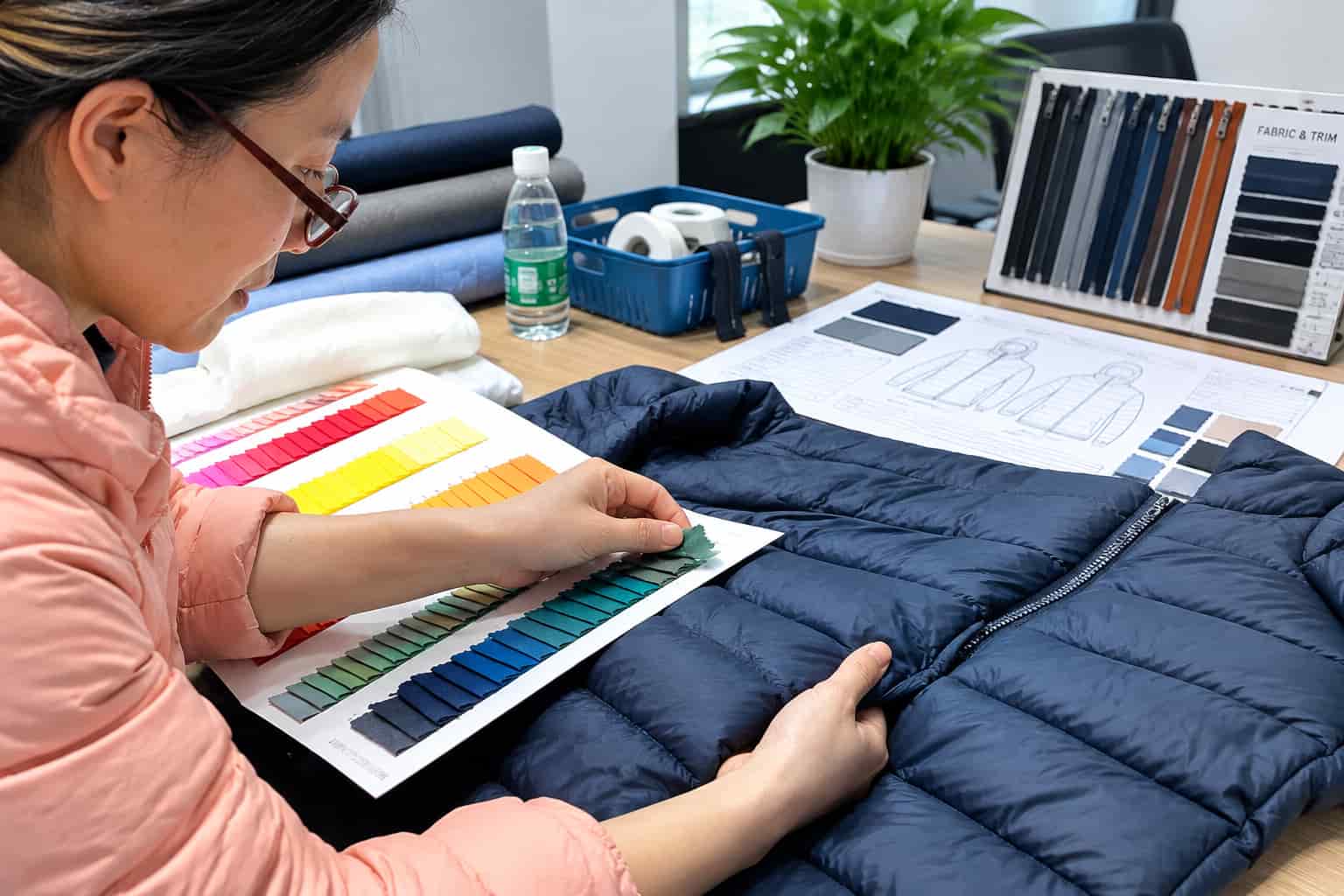
Fabric and insulation are usually among the largest cost factors in a custom jacket quotation, so this is where quotes go wrong fastest without detail. We look for:
Fabric type and GSM (fabric weight)
Face fabric finish — DWR coating, TPU/PU lamination, or membrane (2-layer vs 3-layer construction)
Waterproof/breathability rating, if applicable (e.g. 10,000mm/10,000g)
Insulation type and amount — down fill power (600/700/800) or synthetic fill weight (g/m²)
Lining material
Many brands start with a performance target rather than a final fabric specification. In this situation, an experienced OEM manufacturer can help evaluate suitable fabric options based on waterproof requirements, usage scenarios, and target price level. (See how we approach waterproof jacket manufacturing and seam sealing process for a closer look at construction and sealing methods.)
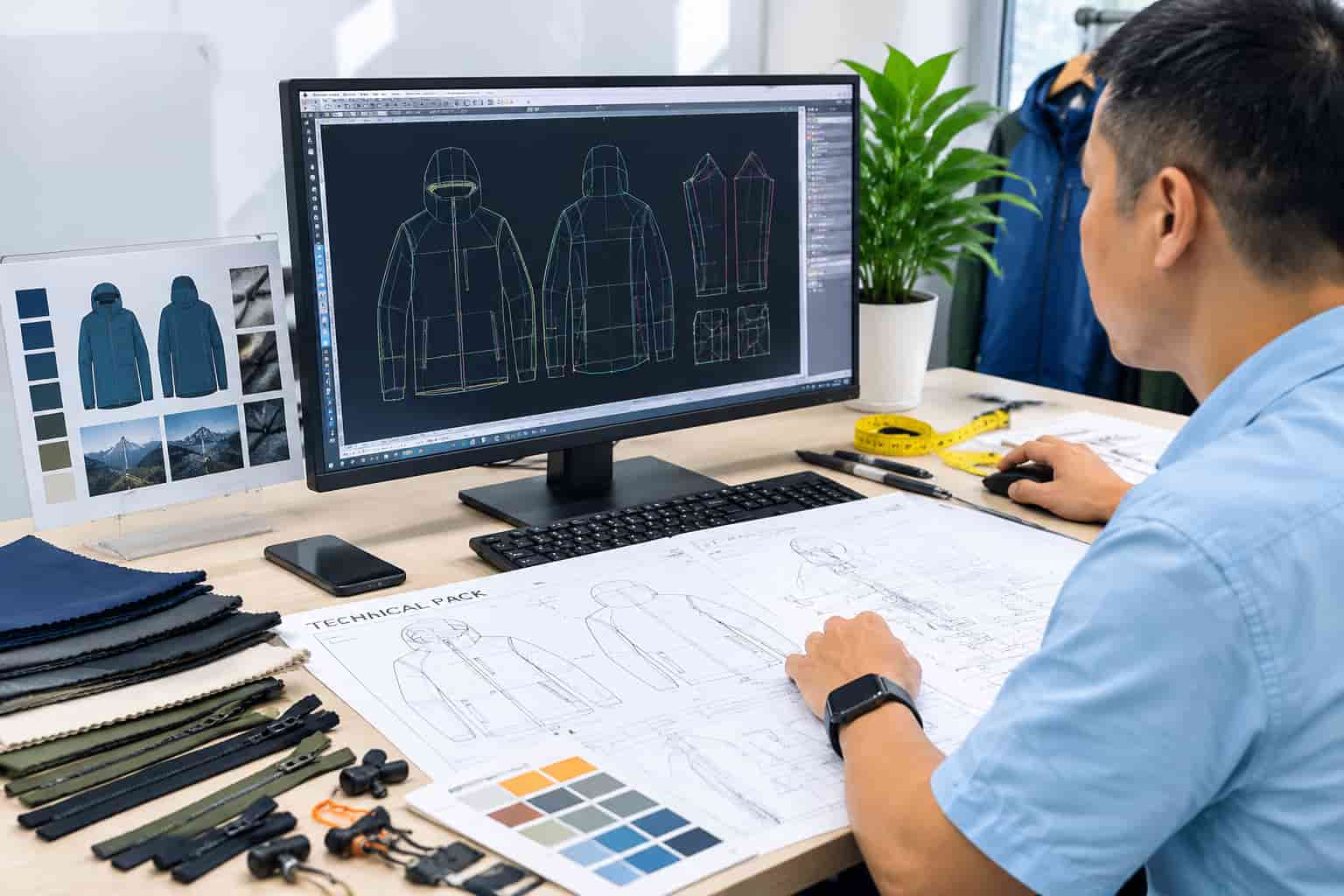
This is usually the single biggest factor in how quickly a quote can be finalized. For technical outdoor jackets specifically, a tech pack should include:
Flat sketches (front/back) with construction callouts
Size chart and grading
Trim details — zippers (YKK vs. generic), snaps, drawcords, elastic
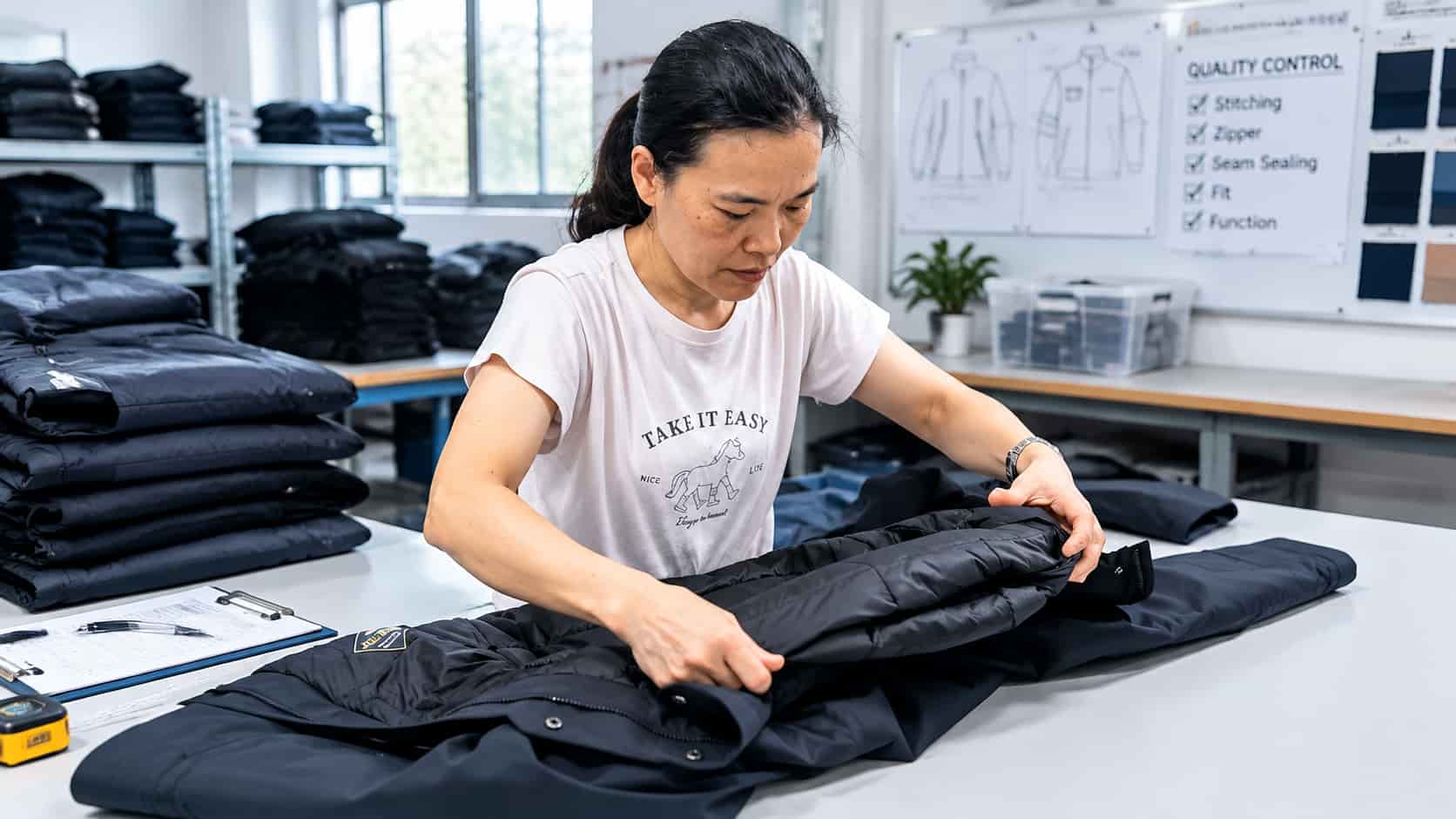
Waterproof requirements and seam sealing/taping requirements
Pocket construction, hood adjustment, cuff construction
Ventilation design and reflective elements, if applicable
Colorways
No tech pack yet? A reference jacket, a mood board, or a rough sketch with dimensions works — we can build a working spec sheet from that, though it does add a step to the development timeline. The more technical details provided upfront, the fewer revisions are usually required during sampling. This is especially important for waterproof and technical outerwear, where construction details can directly affect final garment performance.
Price breaks are typically tied to fabric roll minimums and cutting efficiency, not arbitrary tiers. Useful details:
Total quantity, and how it splits across colors and sizes
Whether this is a trial/sample order or the first run of a repeat program
Quantity below a factory's standard MOQ isn't necessarily a dead end. Ruiniu provides flexible OEM support for selected outdoor jacket projects, helping brands reduce inventory risk before scaling to larger production runs. (Learn more about our low MOQ outdoor jacket production options.)
Private label details affect both cost and lead time:
Woven labels, printed labels, or heat-transfer branding, and their placement
Hang tags, poly bags, or custom retail packaging
Compliance labeling required for your target market (fiber content, care instructions, country of origin)
If your project requires specific certifications or compliance documentation, please confirm them before quotation. Requirements such as RDS, OEKO-TEX, bluesign, or market-specific testing (e.g. CPSIA for the US market) may affect material selection, sourcing lead time, and production planning — so flagging them early avoids rework later.
Required delivery date, and destination port or address
Whether this is tied to a season launch
Lead time affects pricing too: rush timelines can mean expedited fabric sourcing or overtime production, both of which factor into the final cost.
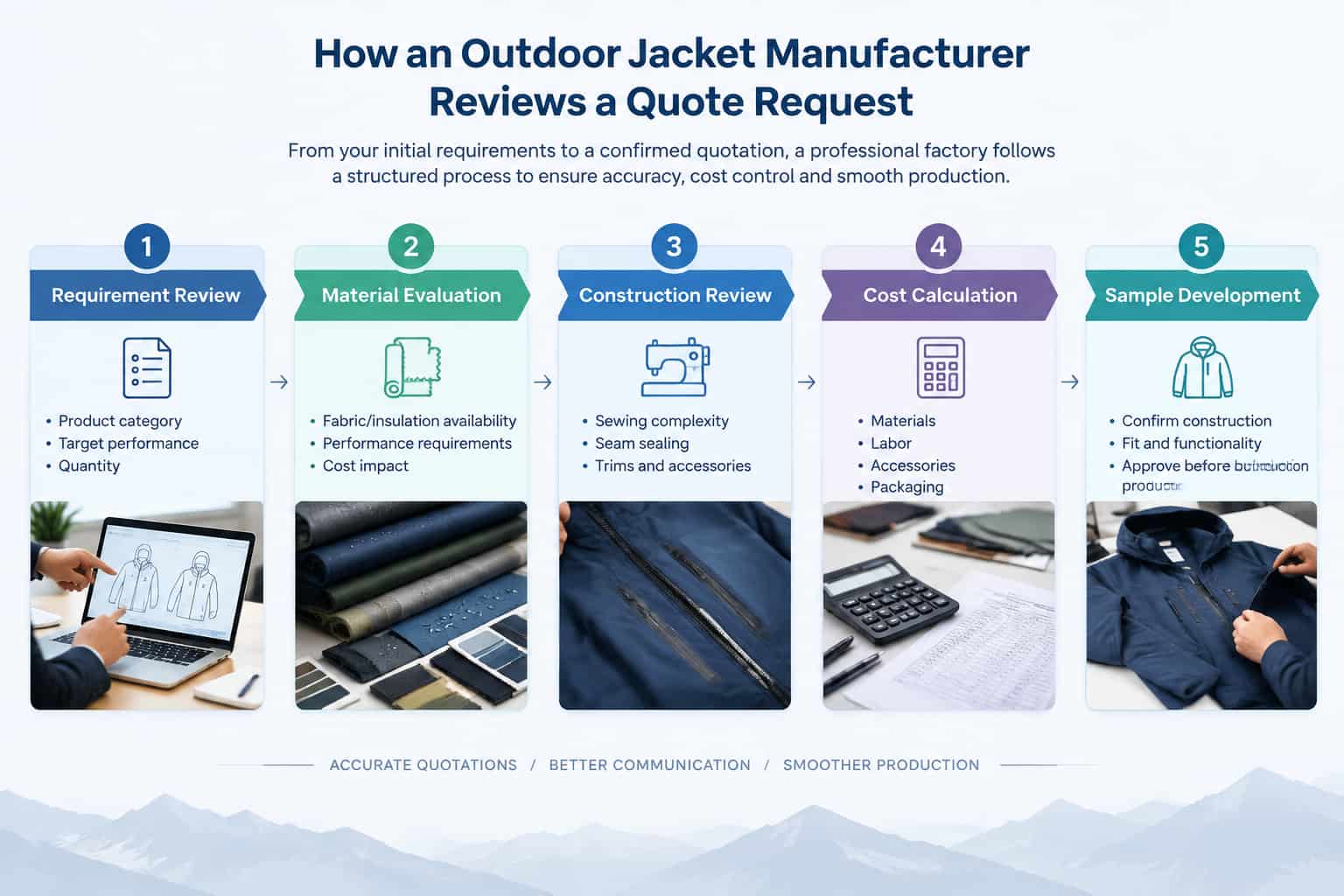
A professional outdoor jacket manufacturer usually reviews a quotation request through the following stages:
| Stage | Factory Review | Requirement review |
|---|---|---|
| 1 | Requirement review | Product category, target performance, quantity |
| 2 | Material evaluation | Fabric/insulation availability and cost impact |
| 3 | Construction review | Sewing complexity, seam sealing, trims |
| 4 | Cost calculation | Materials, labor, accessories, packaging |
| 5 | Sample development | Confirm final construction before bulk production |
Understanding this sequence helps explain why a complete submission gets a fast, firm quote — while a partial one triggers several rounds of clarification before a number can be committed to.
What should I prepare before contacting an outdoor jacket manufacturer?
At minimum, prepare your product category, reference images or tech pack, target quantity, performance requirements, and delivery expectations. The more complete the information, the faster a manufacturer can evaluate materials, construction and pricing.
Can I get a quote without a tech pack?
Yes, though it will typically be a preliminary estimate. A firm quote usually requires confirmed fabric, construction, and trim details.
How long does a custom jacket quotation take?
With complete fabric specs, tech pack, and quantity provided, a firm quote can usually be returned within 24–48 hours. Incomplete requests take longer due to back-and-forth clarification.
What affects outdoor jacket pricing most?
Fabric and insulation choice, waterproof/breathability requirements, construction complexity (seam sealing, trims), and order quantity are typically the largest cost drivers.
Can small brands order custom jackets?
Yes. Many OEM manufacturers provide options for emerging brands, including sample development and smaller trial production runs. Ruiniu supports low-MOQ outdoor jacket projects for brands that need sample development or initial production runs, depending on design complexity and material requirements.
Send us:
Product reference or tech pack
Target quantity
Fabric/performance requirements
Target market
Delivery timeline
Our technical team will review your requirements and suggest suitable materials, construction methods, and production options.
See our outdoor apparel case studies for examples of completed OEM projects, or explore our custom outdoor jacket OEM manufacturing capabilities.