
Down jacket migration happens when baffles are too wide, down-proof fabric or needle setup is wrong, or chambers are overfilled. Fill power and fill weight only cover half the specification — baffle construction, down-proof weave, per-chamber weighing and care labels together determine whether down stays in place after months of wear.
A brand's first down jacket order came back from a customer with a complaint: after two months of wear, most of the down had settled into the bottom third of the jacket. The shoulders were flat. The customer photos showed exactly what you'd expect — a puffy hem and a thin, deflated chest.
The fill weight was correct. It had been checked at final inspection, right down to the gram. What failed wasn't the amount of down. It was the construction that was supposed to keep it in place.
This is the part of down jacket manufacturing that doesn't show up on a spec sheet the way fill power or fill weight does. A jacket can have 700 fill power duck down, the right total weight, and still perform badly if the baffle construction, stitching and down-proof fabric aren't right.
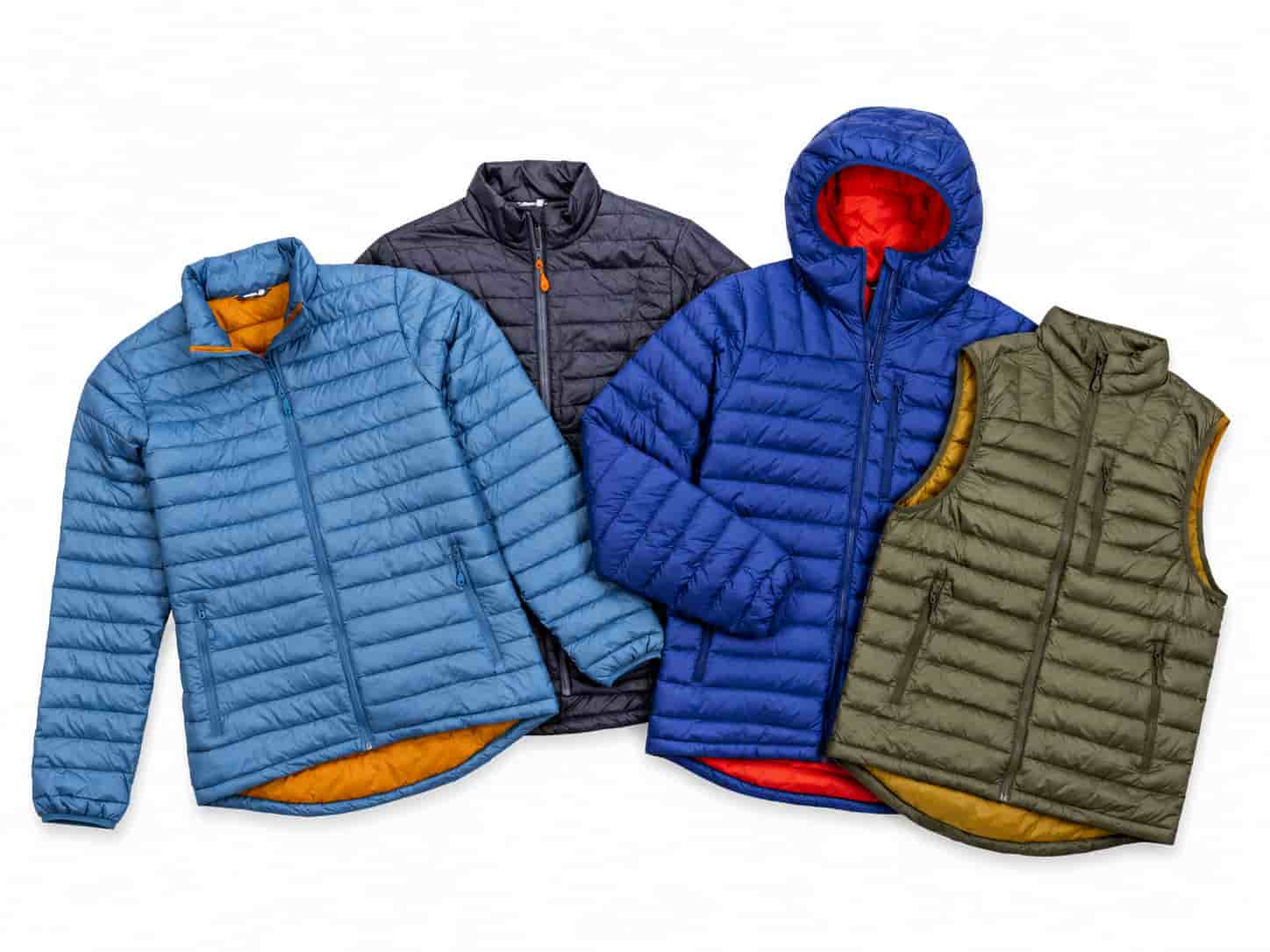
A down jacket isn't one big pocket stuffed with insulation. It's built as a series of separate chambers, called baffles, sewn between the outer shell and the inner lining. Each baffle holds its own portion of down and is closed off from the ones next to it.
Baffle size matters more than most brands expect going in. Wider baffles hold more down per section and feel warmer initially, but the down inside has more room to shift, which is exactly what happened in the customer's jacket above — wide, loosely sewn channels with nothing to stop the fill from migrating downward over time. Narrower baffles restrict movement better but need more stitching lines, which adds needle holes and production time.
There are two main baffle constructions we use, and the choice changes the jacket's behavior, not just its look.
| Construction | How It Works | Advantages | Limitations |
|---|---|---|---|
| Sewn-through | Outer shell stitched directly to lining | Lighter, lower cost, faster to produce | Every stitch line is a cold spot — no down sits directly under the seam |
| Box-wall | A fabric strip separates shell and lining, creating a 3D chamber | Warmer for the same fill weight, no cold spot at the seam | More fabric, more sewing time, needs an experienced operator to keep box walls consistent |
Sewn-through works fine for a lightweight three-season jacket. It's a poor choice for anything marketed as expedition-grade or extreme cold — the cold spots at every seam line are the trade-off for the lower cost and weight.
Box-wall is what we'd recommend when insulation performance is the priority, but it comes with a real production cost: more components, more sewing operations, and more room for inconsistency across a production run if the operator isn't experienced with keeping the box walls even.
A brand that specifies "700 fill power" without specifying baffle construction is leaving one of the two biggest performance variables up to whichever method the factory finds fastest to run.
Down clusters are small enough to work through a loosely woven fabric and its own stitching holes. A shell fabric that looks fine for a softshell jacket can leak down steadily through every needle hole in a filled garment.
Down-proof fabric is woven at a tighter thread count specifically to keep the down clusters from working through the weave, and it's usually treated with a calendaring process — running the fabric between heated rollers — to flatten the fibers and close the gaps further. This is why a down jacket's inner lining sometimes has a slightly stiffer, papery hand feel compared to the outer shell. That stiffness is doing a job.
Needle selection matters here as much as fabric choice. A standard sewing needle punches a hole larger than necessary and leaves a gap the down can work through over time, especially at stress points like the underarm or cuff where the fabric flexes repeatedly. Needle size and stitch density on down-proof seams are set according to the specific fabric and construction for each order — a lighter nylon shell and a heavier down-proof cotton blend don't take the same setup, and we confirm both during sampling rather than defaulting to one fixed setting across every style.
Down filling happens after the shell is sewn into its baffled structure but before the final closing seam. Each baffle is filled individually and weighed on a scale before the opening is closed, not estimated by eye or filled in bulk across the whole garment.
This matters for two reasons. First, fill weight has to be consistent chamber to chamber, or the jacket ends up with visibly puffier and flatter sections even before anyone wears it. Second, overfilling a chamber puts pressure on the seams and increases the chance of a seam failure or down leaking through a stress point that would otherwise hold.
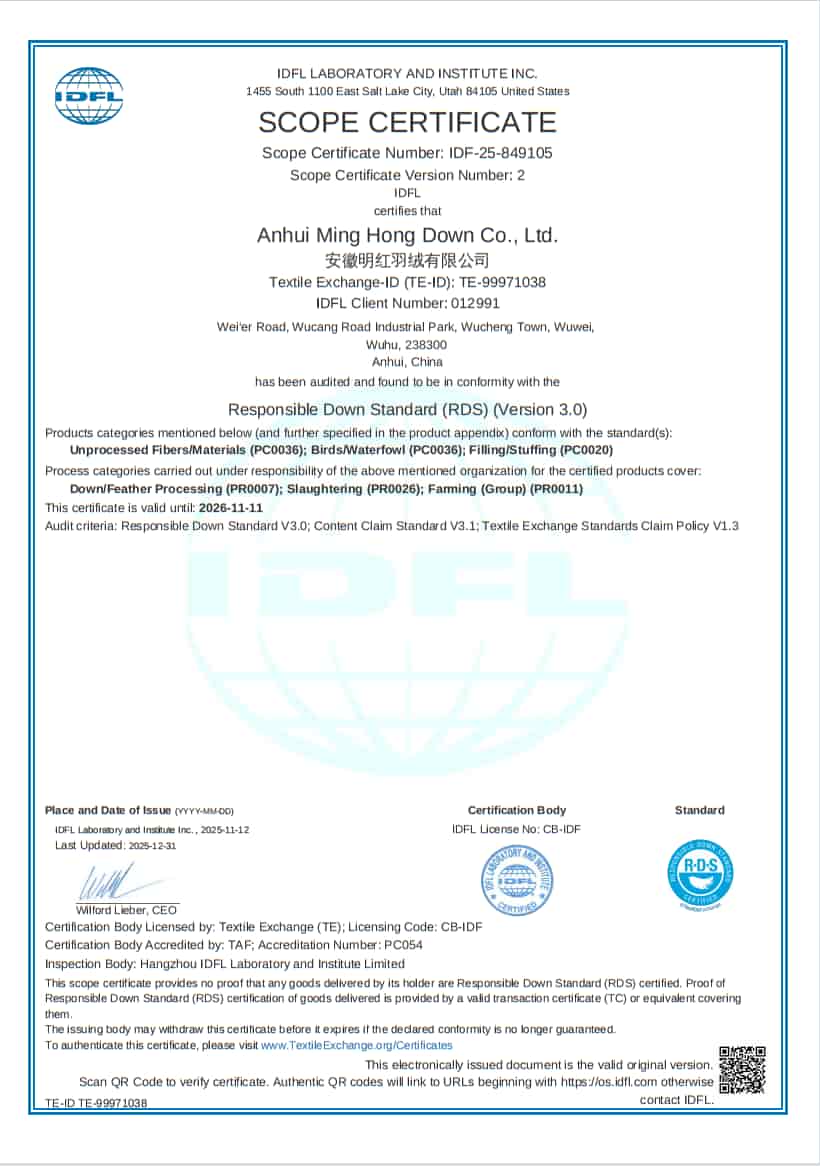
For orders using RDS-certified down, fill is tracked and weighed by batch, and sourcing documentation can be provided according to the agreed material specification — not just labeled "duck down" on a care tag with no paper trail behind it.
Not every migration complaint traces back to the factory. Down naturally redistributes with washing and compression if the jacket isn't stored or cleaned correctly, and it can clump if a jacket is washed without the right detergent or dried without enough tumbling to re-loft the clusters.
This is why care label accuracy matters more on a down jacket than on most other garment types. A jacket engineered correctly can still develop the same flat, bunched appearance if it's washed with regular detergent that strips the natural oils holding the down structure together, or line-dried instead of tumble-dried on low heat with the down given room to re-loft.
We test the recommended care instructions against the actual down and fabric combination used in each order rather than defaulting to a generic care label across every style.
Fill power and fill weight are the numbers most buyers focus on first, and they matter. But they're only half the specification.
Before confirming a down jacket order, it's worth asking a factory to specify baffle construction (sewn-through or box-wall) by garment zone, not just for the jacket as a whole — a hood or collar sometimes uses a different construction than the body for weight or mobility reasons. It's also worth asking what down-proof fabric thread count is being used, and how needle size and stitch density get confirmed for that specific fabric before bulk cutting starts.
If a factory answers these with a shrug and points back to the fill power number, that's usually a sign the construction side hasn't been thought through as carefully as the fill has.
What's the difference between sewn-through and box-wall baffle construction?
Sewn-through stitches the shell directly to the lining, creating a seam with no insulation at that line — lighter and cheaper, but with cold spots at every stitch. Box-wall adds a fabric strip between shell and lining at each seam, creating a full-depth chamber with no cold spot. Box-wall is warmer for the same fill weight but takes more fabric and sewing time.
Why does down leak out of some jackets over time even when the fabric looks fine?
Down clusters can work through both a loosely woven fabric and its own needle holes. Down-proof fabric uses a tighter weave and a calendaring finish to close these gaps. Needle size and stitch density on down-proof seams are confirmed for the specific fabric during sampling, since a lighter shell and a heavier down-proof fabric need different settings.
How is down migration prevented during manufacturing?
Through baffle construction that limits how far down can shift within each chamber, combined with per-chamber weighing during filling so no single section is over or underfilled. Baffle width, in particular, determines how much room the down has to move.
Can down migration happen even if the jacket was made correctly?
Yes. Washing with the wrong detergent or drying incorrectly can strip natural oils and cause clumping that looks identical to a construction defect. This is why we test and specify care instructions against the actual down and fabric combination used, not a generic label.
Do you provide RDS documentation for down jacket orders?
For orders using RDS-certified down, fill is tracked and weighed by batch, and sourcing documentation can be provided according to the agreed material specification.
Send us your tech pack, reference sample or target fill power. Our team based in Foshan, China can review baffle construction, down-proof fabric options and filling requirements before sampling begins.