


If you've spent any time sourcing outerwear for your brand, you already know that not all down jackets are created equal — and neither are the factories that make them.
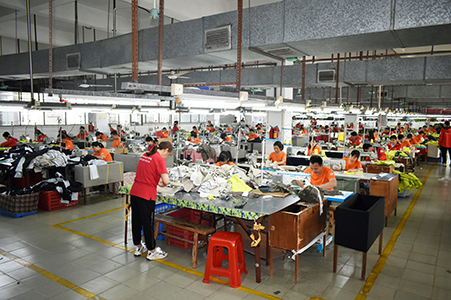
We've been manufacturing custom down jackets in Guangdong, China for over 23 years. In that time, we've worked with outdoor retailers, ski wear brands, private label startups, and wholesale distributors across North America, Europe, and Australia. The questions we get asked most often are always the same: What fill power should I specify? How do I verify a factory's certifications? What's a realistic MOQ for a startup brand?
This guide answers all of those questions — directly, without the fluff.
What Fill Power Actually Means for Your Brand
Fill power is the single most misunderstood spec in down jacket sourcing. It measures the loft of down — specifically, how many cubic inches one ounce of down occupies when fully expanded. Higher fill power means more trapped air, which means more warmth at less weight.
Entry-level performance. Works well for budget retail lines and promotional jackets. Lower cost per unit, but noticeably heavier than premium alternatives for the same warmth rating.
A practical option for most mid-market brands. Strong warmth-to-weight ratio, accessible price point, and sufficient performance for most winter conditions outside of extreme alpine use.
Premium territory. This range supports competition with well-known outdoor brands on raw material quality. Significantly lighter and warmer than mid-range fill, but the cost increase is substantial. Suitable for technical outdoor brands targeting performance-focused consumers.
Beyond fill power, the fill ratio matters. A 90/10 ratio — 90% down, 10% feather — supports good loft, softness, and warmth retention. An 80/20 ratio costs less and still performs well for most retail applications. Some budget manufacturers use 70/30, which may not fit brands positioned above the value segment.
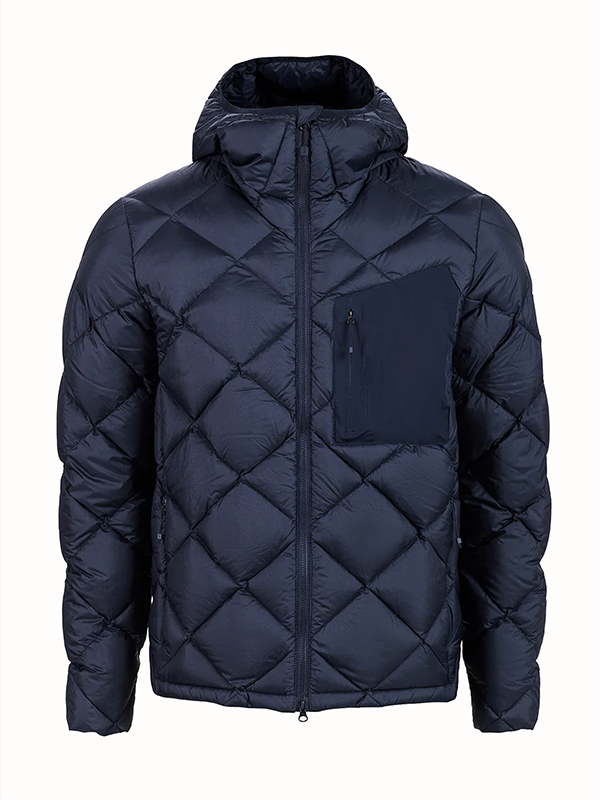
For B2B buyers sourcing custom down jackets for the first time, starting with 700FP white duck down at a 90/10 ratio creates a product that performs well, photographs beautifully, and sits at a price point that works for most wholesale and retail margins.
The outer shell determines how your jacket looks, feels, and performs in real conditions. It also has a major impact on your unit cost and your sustainability story — increasingly important for brands selling into European and North American markets.
A widely used material in the industry. Lightweight, strong, naturally wind-resistant, and available in a wide range of weights and finishes. Most technical outdoor brands use 20D–50D nylon ripstop for their shells. Higher denier means more durability; lower denier means lighter weight and better packability.
More affordable than nylon and offers excellent color retention — important for brands with bold colorways. Slightly heavier and less technical in feel, but appropriate for fashion-forward outdoor and lifestyle brands.
Demand for recycled shell fabrics has grown sharply since 2023. European retailers in particular encourage brands to include recycled content across their lines. Recycled fabrics carry a small cost premium — typically 8–15% above virgin equivalents — and support sustainability positioning for most brands.
All shells used in our custom outdoor jacket production are treated with C0 DWR — a PFC-free durable water repellent coating that meets current EU environmental regulations and is requested by most major retail buyers.
For any brand planning to sell into Western retail — whether that's independent outdoor stores, department stores, or major e-commerce platforms — factory certifications support market access and compliance.
BSCI: Verifies ethical working conditions, fair wages, legal employment, and safe factory environments. Most European retailers request BSCI certification before placing orders.
RDS (Responsible Down Standard): Certifies that all down and feathers come from animals that have not been subjected to live-plucking or force-feeding. It has become a common requirement for outdoor brands.
ISO 9001: International quality management certification. Shows consistent production processes and continuous improvement systems.
ISO 14001: Environmental management certification. Often requested by sustainability-focused brands and retailers.
OEKO-TEX Standard 100: Certifies that all components are free from harmful substances. Important for children’s wear and health-focused product lines.
Ruiniu Garment holds BSCI certification and works with RDS-certified down suppliers. Full documentation is available on request.
Our minimum order quantity is 100 pieces per style. This supports startup brands testing new products while remaining efficient for established brands scaling existing lines. For orders above 500 pieces per style, we offer tiered pricing with cost reductions at higher volumes.
Physical samples are produced within 7–10 business days of tech pack approval. We recommend all clients approve a physical sample before bulk production — handling a finished garment shows fit, fill distribution, and hardware feel clearly.
Standard bulk lead time is 30–45 days after sample approval and deposit payment. Complex styles with embroidery, special hardware, or multi-component construction may require additional time.
Sea freight from Guangdong to major ports in the USA, Canada, and Europe runs 20–35 days. Air freight is available for urgent orders.
From first inquiry to goods arriving at your warehouse: 60–90 days. Brands targeting winter selling seasons can initiate contact by June for stable delivery.
| Jacket Type | Estimated Unit Price (USD) |
|---|---|
| 600FP white duck down jacket, nylon shell, 100pcs | $22–$32 |
| 800FP white goose down jacket, recycled nylon shell, 200pcs | $38–$55 |
| Technical ski down jacket with custom features, 300pcs | $45–$70 |
These are indicative ranges. A formal quote with your tech pack will provide accurate pricing.
Tech Pack Submission and Review – Complete details reduce sample revisions and delays
Material Sourcing – From qualified suppliers with quality agreements
Cutting and Preparation – Computer-aided systems for consistency
Sewing and Assembly – Specialized down filling and baffle technology
Inline and Final Quality Control – Multiple checks for stitching, down distribution, and function
Finishing and Packaging – Steaming, labeling, and custom packing options
Recycled content in fabrics and fill materials
PFC-Free DWR water repellent treatments
Full supply chain traceability documentation
RDS certification for down and feather products
Choosing a factory based only on price
Skipping the physical sample approval stage
Underestimating seasonal production timelines
Ignoring certification requirements late in the process
Providing an incomplete tech pack
Guangdong province — specifically the Pearl River Delta region — hosts a high concentration of technical outerwear manufacturers. The regional supply chain for fabrics, zippers, down, and trims is mature. Material lead times are shorter, quality is consistent, and export infrastructure supports international brand timelines. Workers in the area often have extensive experience in outerwear production techniques.