
If you're sourcing custom outdoor jackets from China, you'll probably have questions about MOQ, sampling, custom fabrics, lead times, and quality control.
Before moving forward with sampling or production, most brands want answers about intellectual property protection and production capacity. Below are the questions our team is asked most frequently by outdoor brands, importers, and sourcing managers.
OEM (Original Equipment Manufacturing) means a factory produces garments based on your designs, specifications, branding, and technical requirements.
You provide the tech packs, artwork, size charts, fabric requirements, and branding details. The manufacturer produces the garments according to your specifications. OEM manufacturing is the preferred option for brands that want unique products rather than using existing factory designs.
With OEM manufacturing, the product is developed according to your design. With ODM manufacturing, the factory provides existing styles that can be customized with your logo and branding.
OEM is typically chosen by established brands seeking product differentiation. ODM is often suitable for businesses that want to launch products faster and with lower development costs. For a detailed comparison, see our comprehensive guide on OEM vs ODM Outdoor Jacket Manufacturing.
Yes. Most professional outdoor jacket manufacturers work directly from customer tech packs.
A complete tech pack usually includes your technical drawings, measurement charts, material specifications (fabric/membrane/trims), and logo placement artwork. If your tech pack is incomplete, an experienced development team can often help clarify production details before sampling begins.
Yes. Many outdoor brands prefer to protect new product concepts before development starts. A professional manufacturer should be willing to review and sign a reasonable non-disclosure agreement (NDA) before receiving detailed product files to safeguard your intellectual property.
Professional manufacturers protect customer information through strict internal protocols. We utilize restricted file access, internal project management controls, and firm customer-owned artwork policies. RUINIU never uses customer logos, artwork, or proprietary designs without written authorization.
Minimum Order Quantity (MOQ) depends on several factors, including fabric type, fabric color, printing, and custom trims.
While standard custom technical fabrics require 500–1,000 pcs per color, For brands using stock functional fabrics, lower MOQs may be available, typically starting from 100–300 pcs depending on style complexity and material availability.For a detailed breakdown of costs and requirements, please read our Complete Guide to Custom Jacket MOQs.
Sampling timelines vary depending on product complexity. Typical timelines include:
Pattern development: 3–5 working days
Sample production: 7–10 working days
Revisions: 5–7 working days
Projects involving custom technical fabrics, complex pocket construction, or specialized waterproof welding may require additional development time. Discover our full sample-to-delivery timeline in our step-by-step guide: How Long Does It Take to Develop a Custom Jacket Sample in China.
Yes. Professional outdoor apparel manufacturers typically maintain long-term relationships with technical fabric mills and trim suppliers.
Common sourcing options include waterproof/breathable fabrics, softshell fabrics, recycled polyester, and PFAS-free (C0) eco-friendly materials. We also source high-performance trims such as YKK zippers and Bemis adhesive films to ensure production consistency.
Yes.
Many startups and emerging outdoor brands do not have established relationships with fabric mills.
An experienced outdoor apparel manufacturer can often recommend suitable materials based on product requirements, target price points, waterproof ratings, and intended use.
Common options include:
Softshell fabrics
Waterproof breathable fabrics
Recycled polyester fabrics
PFAS-free materials
Downproof fabrics
Material recommendations should always be verified through sampling and testing before bulk production.
Yes. Private label production generally includes woven labels, heat transfer tags, customized hangtags, branded polybags, and personalized zipper pulls. Many startups and retailers choose private label manufacturing as a cost-effective way to build their own unique outdoor apparel brand identity.
Quality control occurs throughout the manufacturing process rather than only at the final inspection stage. Typical quality checkpoints include incoming material inspection, pattern verification, pre-production sample approval, in-line sewing inspection, and final random quality auditing.
For waterproof garments, critical seam areas undergo strict hydrostatic pressure testing and seam leakage verification to ensure performance standards.
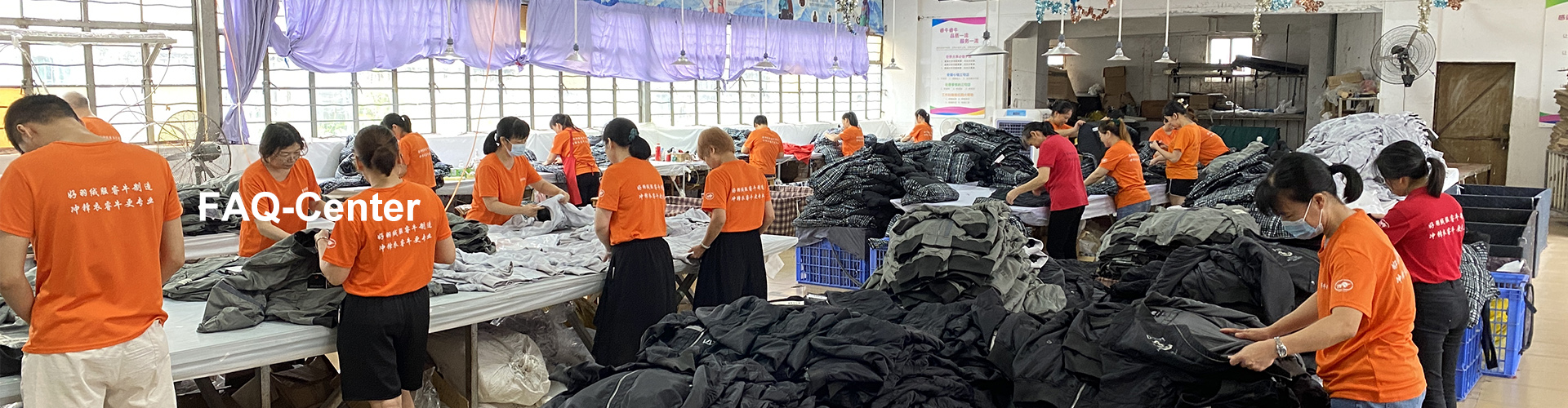
Absolutely. We welcome and encourage transparency. Many buyers choose to visit our facility in Foshan, Guangdong, to inspect production lines, the sample development room, the fabric warehouse, and our specialized quality testing equipment.
If international travel is not convenient, a live video factory tour can easily be arranged. Check out our verification framework to see how we operate: How to Verify a Real Clothing Factory in China and Avoid Trading Companies.
Production lead time depends on order quantity, fabric availability, product complexity, and seasonal workload. Most outdoor jacket orders require approximately 30–60 days after sample approval and deposit confirmation. The exact timeline should always be locked down before production begins.
Yes. Environmental compliance is becoming an essential sourcing requirement rather than just a marketing advantage.
We fully support eco-compliant production, including PFAS-free (C0) DWR treatments, recycled fabrics (GRS certified), and OEKO-TEX certified materials. At RUINIU, Our development team has experience working with PFAS-free waterproof fabrics and fully taped garment construction for European outdoor brands, helping ensure both environmental compliance and reliable waterproof performance.
Yes. Many successful global outdoor brands started with relatively small production runs. When working with startups, we focus on realistic MOQ planning, fabric availability, cost control, and product development efficiency to simplify the sourcing process and reduce common manufacturing mistakes.