

By Iris Jiang, Outdoor Apparel QC and OEM Content Lead at RUINIU · Updated November 12, 2026
A sustainable puffer jacket is not created by printing “recycled” on one component. We specify the shell, insulation, finish and construction separately, then keep the evidence tied to the finished garment. If a claim cannot be proved, we do not put it on the hangtag.
Quick answer
For a sustainable puffer jacket program, record the material composition, certificate holder and claim scope for every component. Approve fill power and fill weight by size, test leakage and wash recovery on the finished jacket, and keep each lot connected to its production record.
What Sustainable Puffer Jacket Should Mean
“Recycled shell” is a shell claim. “Responsible down” is a fill claim. Neither one certifies the whole jacket. For the wider material checklist, see our guide to sustainable fabrics for outdoor brands.
A search for an “eco-friendly puffer jacket” points to exactly the kind of broad wording that needs evidence in the EU. Directive (EU) 2024/825 has applied across Member States since 27 September 2026. It prohibits generic environmental claims such as “eco-friendly”, “green” or “sustainable” unless the trader can demonstrate recognised excellent environmental performance relevant to the claim. Read the official EU directive, confirm national implementation details and review final wording with legal advisers.
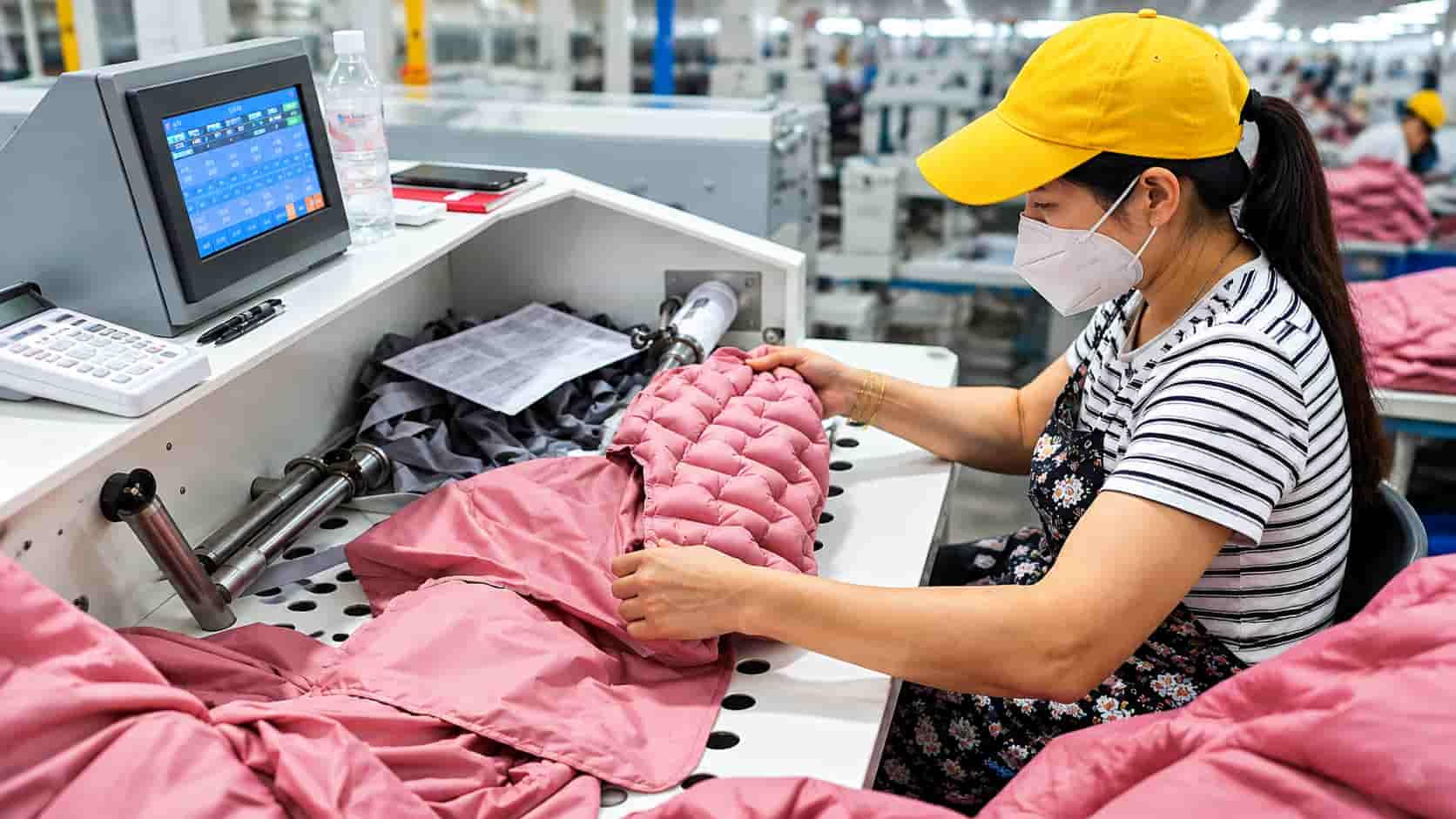
5,000 Packable Down Jackets for a Nordic Outdoor Brand
Client A was a Nordic outdoor brand developing its 2024 autumn and winter range for city light outdoor use and cold climate commuting. We handled OEM and ODM work from sampling and fabric development through fill sourcing, garment production and test submission. The product was a hooded, mid length, packable down jacket developed in men’s and women’s versions.
Orders
Quantity: 3,200-piece first order in 3 colors, sizes S–XL; 1,800-piece repeat order; 5,000 pieces total
Timing
Sampling: 62 days across 4 sample rounds
Bulk: First bulk 45 days; repeat order 30 days
Release standard
Appearance: AQL 2.5
Critical functional items: Zero defects
Why 62 days? The four sample rounds used 21 working days (8 + 5 + 5 + 3). Fabric development and two material changes used 22 days, client approval and Nordic sample shipping used 11 days, and third-party testing used 8 days. These stages ran in sequence, which gives 62 days in total. A comparable project baseline was 44 days, so this project ran 18 days longer.
For reference, a single sample round normally takes 7 to 10 business days. This project needed four rounds and two material changes, which is why the total was far longer.
The Production Specification We Approved
Shell
Material and construction: 20D recycled nylon 6 high-density downproof fabric, 38 g/m², no coating, fluorine-free C0 DWR
Result: Hydrostatic pressure 800–1,200 mm; moisture vapor >5,000 g/m²/24h; air permeability ≤5 mm/s; recycled-content evidence supplied with the lot; water repellency after 20 home washes graded 3 or higher
Lining
Material and construction: 20D recycled polyester taffeta with downproof calendering
Result: GRS material documentation and downproof approval
Fill
Material and construction: 90/10 white duck down, 700 FP, RDS; 180 g in size M, each piece weighed, ±3% tolerance
Result: IDFL down test; 20 washes under the client’s specified home-laundry program; measured loft loss 5.2%
Baffles
Material and construction: 12 cm stitched baffles with #9 downproof sewing and extra backing at key areas
Result: Four-hour tumble leakage test passed
Trims
Material and construction: Recycled polyester zipper tape, fluorine-free water repellency, YKK #5 two-way main zipper
Result: Function checked before release
Water-repellent finishes are commonly checked after 5, 10 or 20 home washes, so 20 washes sits at the stricter end of that range. For the shell, durable water repellency was tested after 20 washes under both the AATCC 135 and ISO 6330 home-laundering procedures, then rated with the AATCC 22 and ISO 4920 spray tests. All results were grade 3 or higher.
Test reports for this project are available to qualified buyers on request, including the IDFL down test, the 20-wash loft and water-repellency results and the tumble leakage test.
Why the Shell Did Not Use a 10K Rating
The original brief applied a hard-shell specification to a lightweight down jacket: 10K hydrostatic pressure, 10K moisture vapor transmission and 10K breathability. We rejected that shortcut. The uncoated 20D / 38 g/m² downproof fabric measured 800–1,200 mm. Reaching 10K would require a coating or membrane, lifting fabric weight to about 58–85 g/m², making the hand feel harder and, in one three-layer option, adding about 35% cost. For this puffer, down leakage, wind protection, durable water repellency and wash recovery mattered more than copying a shell-jacket table.
Why nylon 6 rather than nylon 6.6? The selected shell was recycled nylon 6 from a supplier able to provide a complete GRS transaction certificate and source statement for the lot. Nylon 6.6 was not selected because the available supply was narrower and the offered lots did not provide the same documentation and batch consistency for this program. Nylon 6 and nylon 6.6 are different polymer specifications; they should not be treated as interchangeable in a buyer brief.
What We Rejected and Why
100% post-consumer reclaimed down: we did not approve it because the source chain could not be closed. RDS addresses animal welfare at the farm and GRS addresses recycled materials; neither proved this reclaimed-down origin. Two batches tested at 590–620 FP against the 700 FP target, needed about 15% more fill and varied in fill content, odor and dust. We changed to traceable RDS 700 FP new down.
Needle-free bonded baffles: on the 20D recycled nylon, peel strength after 20 washes fell below 70% of the required value and local bubbling appeared. New tooling would have added about 9%, and a bonded leak could not be repaired. We returned to stitched baffles with downproof backing.
20K/20K three-layer fabric: the client dropped it because 75–85 g/m² and a harder hand conflicted with the city-commute brief.
Four Sample Rounds and the Cost of Changing Course
Proto
Result: Reclaimed down and bonded baffles failed loft and peel checks
Days: 8
Fit sample
Result: RDS fill and stitched baffles; fit too large and fill uneven
Days: 5
SMS
Result: Adjusted fill and baffle width; ΔE exceeded target and DWR hand was too hard, so the lot changed
Days: 5
PP sample
Result: Client signed off the final construction
Days: 3
The project cost rose about 6% because of the RDS premium, two material changes and repeat testing. The repeat order reused the approved construction without another sampling cycle.
How We Track the Batch
Our quality-control page describes centralized ERP tracking: every jacket bundle carries indicators linked to its yarn lot, chemical certificate and manufacturing line. It also lists 100% incoming fabric inspection, 24 inline checkpoints and AQL 2.5 outbound sampling. For this project, GRS documentation came from the fabric supplier and RDS documentation came from the down supplier; neither is presented as a factory-wide certification. We kept the approved swatch, color standard, fill record, lot documents, sample photos and test submissions in the customer file.
Three Lessons We Use in Later Quotes
When a buyer asks for reclaimed down, ask who will provide the source proof before quoting it as approved.
When a hard-shell rating is copied into a down-jacket brief, show the added weight, hand-feel and cost before the buyer signs the specification.
Write the included sample rounds into the quote. This project needed four rounds and ran 18 days beyond the comparable 44-day baseline.
Frequently Asked Questions
Is reclaimed down always more sustainable?
No. Without a closed source record and repeatable fill performance, the claim is difficult to defend. A documented RDS fill may be the more reliable production choice.
What does ERP batch traceability mean for a puffer jacket buyer?
It links the jacket bundle to its yarn or fabric lot, chemical certificate and manufacturing line, so a repeat order can be checked against the approved records.
Should a down jacket use a 10K waterproof shell?
Not automatically. For this city-commute project, downproof construction, air permeability, DWR and wash recovery were more relevant than copying a hard-shell rating.
Review a Sustainable Puffer Jacket Brief
Send the target climate, shell and fill requirements, claim wording and reference sample for a documented construction review.