

10K vs 20K Waterproof Fabric: Which Is Right for Your Brand?
Meta Description: Choosing between 10K and 20K waterproof fabric for your outdoor jacket line? This practical guide covers specs, membrane types, manufacturing costs, and how to match the right rating to your market — without over-engineering your product.
A brand came to us last year wanting to develop a hiking jacket for the European travel market. Their brief said "20K waterproof minimum." When we asked why, the answer was: "because it sounds more premium."
That jacket would have retailed at $180. With 20K fabric, full seam taping, and a 3-layer construction, it would have needed to retail at $260 just to maintain a reasonable margin — pricing it out of the very market they were targeting.
We spec'd it at 10K. It sold well. The customer never noticed the difference, because for weekend hiking in Western Europe, they never would.
This is the conversation we have with brands repeatedly: waterproof ratings are not a marketing race. They are a specification decision, and the right one depends entirely on what your jacket actually needs to do.
What 10K and 20K Actually Mean
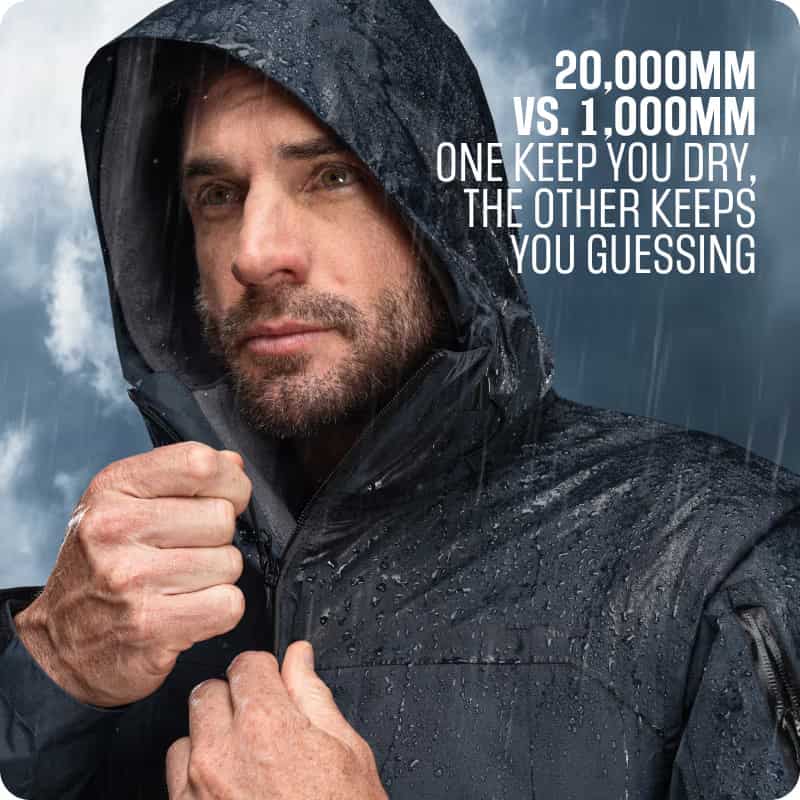
The numbers come from the Hydrostatic Head Test, an industry-standard test governed by ISO 811. A fabric sample is placed under a column of water, and the height of water (in millimetres) at which moisture starts to penetrate determines the rating.
10,000mm means the fabric holds against a 10-metre column of water. 20,000mm holds against 20 metres.
In practical terms: standing rain generates roughly 2,000mm of pressure. Someone kneeling on wet ground creates around 4,000mm at the knee. Sitting on a wet ski lift for an hour on a heavy snow day can push past 10,000mm at sustained contact points.
So 10K handles hiking in heavy rain. 20K handles a ski day. Both are genuinely waterproof — the difference is where each one starts to let water through under pressure and over time.
What the number alone doesn't tell you is the membrane behind it, how the jacket is constructed, or whether the seams are sealed. A jacket with 20K fabric and untaped seams will leak faster than a well-made 10K jacket with full seam taping. The rating on the fabric is just one part of a complete waterproof system.
The Membrane Matters More Than the Number
Two jackets can both claim 20K and perform very differently. The reason is almost always the membrane type.
PU coating is the most common waterproofing method at the entry and mid level. A polyurethane layer is applied directly to the inside of the fabric. It works well, costs less, and is widely available from fabric mills across Taiwan, South Korea, and China. The limitation is longevity — PU coatings soften and lose effectiveness with repeated washing and abrasion. For a $120–$180 jacket that a customer expects to last a few seasons, PU at 10K is perfectly appropriate.
TPU membrane is a step up. Instead of a coating applied to the surface, a thermoplastic polyurethane film is bonded (laminated) to the fabric. The bond is more durable, the breathability more consistent, and the performance holds better across the life of the garment. Most 20K fabric at serious outdoor brands uses a TPU membrane. It costs more per metre, but it earns its price over the product's lifetime.
e-PTFE membrane — the technology behind Gore-Tex and similar premium products — is the high end. Expanded polytetrafluoroethylene is a microporous film that allows vapour to pass through while blocking liquid water. It gives you high waterproof ratings alongside genuinely excellent breathability. The catch: it requires certified manufacturing partners, the fabric cost is significantly higher, and the minimum order quantities can be demanding. Unless you're building a product at the $400+ retail tier with a clear technical positioning, e-PTFE is usually unnecessary.
For most brands developing custom waterproof jackets in the $150–$350 range, TPU membrane at 10K or 20K is the practical sweet spot.
Layer Construction: 2L, 2.5L, 3L
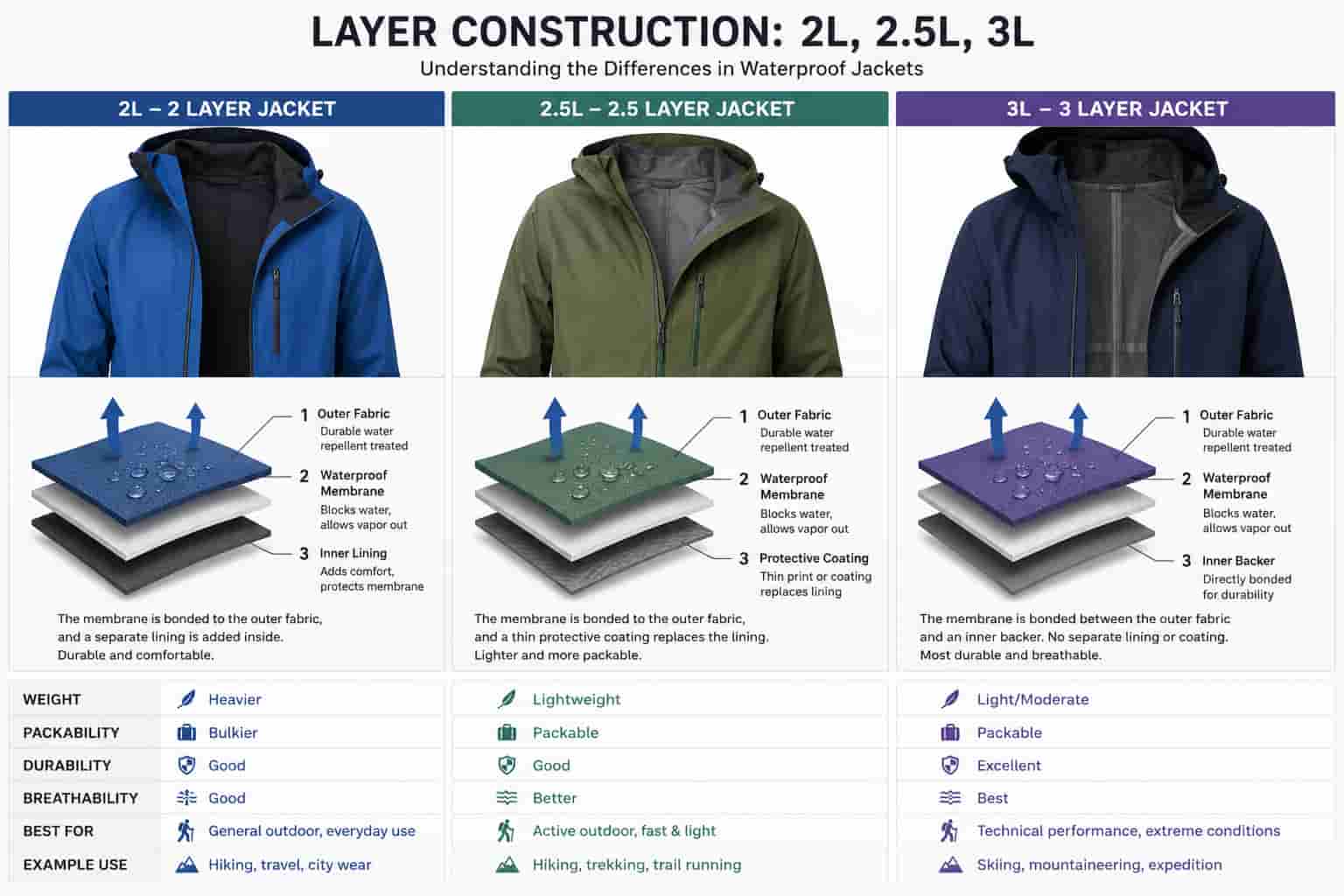
The membrane type answers what is waterproofing the fabric. The layer construction answers how it's put together — and this has a direct impact on weight, packability, cost, and how the jacket feels to wear.
A 2-layer jacket bonds the membrane to the outer face fabric, then adds a separate inner lining (usually mesh or tricot). The lining protects the membrane from abrasion and makes the jacket more comfortable against the skin. It's the most common construction for everyday rain jackets and travel outerwear. Heavier, slightly bulkier, but cost-effective and consumer-friendly.
A 2.5-layer jacket skips the separate lining and instead prints or laminates a thin protective finish directly onto the membrane's inner surface. This allows the jacket to pack down smaller and lighter. Most packable rain jackets and trail running shells use this construction. The ".5" refers to that partial inner layer — it's not a full lining, but it gives the membrane some protection.
A 3-layer jacket laminates the outer fabric, membrane, and inner backer together into a single bonded unit. No separate inner lining needed. The result is lighter per unit of performance, more durable, and more breathable because vapour doesn't have to pass through a separate lining layer. It's also the most expensive to produce. For 20K technical outerwear — ski shells, alpine jackets, expedition gear — 3-layer is the standard. For a $160 hiking jacket, it's hard to justify the cost.
Seam Sealing: Where Most Brands Get It Wrong
Fabric waterproofness means very little if the seams leak.
Every time a needle passes through waterproof fabric, it creates hundreds of small holes. In light rain, this may not matter. In sustained heavy rain, those holes become entry points for water — and you'll hear about it in reviews.
Seam sealing is the process of applying waterproof tape over the interior seams to close those holes. There are two levels:
Critical seam taping covers the major structural seams — shoulders, underarms, chest. It's appropriate for 10K jackets positioned for hiking and general outdoor use. Most customers in this category won't experience conditions severe enough to notice the unsealed secondary seams.
Full seam taping covers every seam in the jacket. Required for anything marketed as a ski shell, mountain shell, or professional outdoor product. If you're charging a premium and promising 20K performance, full seam taping is non-negotiable. Water will find an untaped seam under sustained exposure.
When developing a custom waterproof jacket, confirm the seam treatment in the tech pack — not as an afterthought, but as part of the initial specification.
DWR: The Invisible Layer That Keeps Breathability Working
Here's something that catches brands off guard: a technically waterproof jacket can feel like it's failing without any actual waterproof failure.
When the outer face fabric becomes saturated — even if no water has penetrated the membrane — the jacket "wets out." A wet-out jacket loses most of its breathability because moisture vapour can no longer pass easily through the waterlogged outer layer. The wearer gets wet from sweat, and concludes the jacket is leaking. Sometimes they're right. Often, they're experiencing wet-out.
DWR (Durable Water Repellent) is the finish applied to the outer face fabric that causes water to bead up and roll off rather than soaking in. It doesn't add waterproofness — the membrane handles that — but it keeps the outer fabric dry and keeps the breathability working.
DWR wears off over time, especially with washing and friction. When a customer says "my jacket isn't as waterproof as it used to be," the likely culprit is degraded DWR rather than membrane failure. It can often be restored with a wash-in DWR treatment.
For jacket development: specify the DWR standard in your tech pack. C6 fluorocarbon-free DWR is now the industry direction given regulatory pressure on PFAS chemistry, and many outdoor retailers in Europe and North America require it. C6-free DWR performs well for most applications, though it may require more frequent re-treatment than older C8 formulations.
10K vs 20K: Which One Does Your Brand Actually Need?
The decision isn't really about which number is bigger. It's about where your customer is going and what your product needs to survive there.
10K is the right specification for:
Hiking jackets, rain jackets, travel outerwear, softshell jackets with a waterproof layer, urban outdoor apparel, and anything positioned for general or recreational outdoor use. It handles moderate to heavy rain without issue. It supports mid-market retail pricing. It's what the majority of outdoor consumers actually need, even if they don't know it.
20K is the right specification for:
Ski jackets, snowboard outerwear, mountaineering and alpine shells, sailing and marine gear, and any product designed to perform in sustained harsh conditions over multiple hours. If your customer is sitting on a chairlift in wet snow, kneeling in alpine terrain, or working outside in heavy weather, 20K is justified. So is the higher retail price that comes with it.
| 10K Waterproof | 20K Waterproof | |
|---|---|---|
| Hydrostatic Head | 10,000mm | 20,000mm |
| Typical Membrane | PU or TPU | TPU or e-PTFE |
| Construction | 2-layer or 2.5-layer | 2.5-layer or 3-layer |
| Seam Treatment | Critical seams taped | Fully taped |
| Heavy Rain | Handles it well | Handles it comfortably |
| Extended Ski/Alpine Use | Adequate for casual use | Designed for it |
| Relative Fabric Cost | Lower | Higher |
| Retail Positioning | Mid-range | Premium |
What This Means for Manufacturing Costs
Moving from 10K to 20K isn't just a fabric upgrade — it changes the cost of several elements simultaneously.
The membrane itself costs more. TPU laminated fabric runs higher per metre than PU-coated fabric, and the premium widens further if you're moving to e-PTFE. For a full jacket cut, that difference adds up.
Full seam taping takes more time on the production line and uses more tape material. It's not a dramatic cost difference per unit, but it's real and it compounds across an order.
Quality control requirements are stricter. A 20K performance jacket needs hydrostatic head testing on finished garments, DWR performance checks, and ideally wash durability testing to confirm the membrane and coating hold after repeat laundering. These aren't optional for a credible premium product — they're what separates a jacket that delivers on its spec from one that doesn't.
Certifications add cost too. If your target markets require bluesign®-approved fabric, OEKO-TEX® certification, or recycled content for sustainability positioning, factor those costs in early. The fabric options that meet those certifications are more limited and priced accordingly.
None of this means 20K is a bad investment. It means the retail price needs to reflect the full cost of the specification — including production complexity, not just fabric.
Building a Range That Uses Both
The brands that do this best don't try to pick one specification for their entire line. They build ranges.
An accessible entry product at 10K PU or TPU, 2-layer construction, critically-taped seams — priced to reach the widest possible customer base. A technical performance product at 20K TPU or e-PTFE, 3-layer construction, fully-taped seams — priced for the customer who compares specs and expects the jacket to work on a serious ski trip.
Both products can carry the same brand identity. They serve different customers and different moments. The 10K jacket brings customers in at a price that works for them. The 20K jacket earns credibility with the performance buyer and justifies the range.
This is a more sophisticated approach than picking the highest spec and applying it across the board — and it tends to produce better commercial outcomes.
A Note on Breathability
One specification that should always sit alongside the waterproof rating, particularly for active-use products, is breathability. Measured in g/m²/24h (MVTR), it describes how effectively the fabric allows moisture vapour — sweat — to escape.
A waterproof jacket that doesn't breathe will make the wearer wet from the inside. For a commuter in light activity, low breathability is uncomfortable but tolerable. For a ski tourer or endurance hiker, it's a deal-breaker.
As a rough working guide: 10,000 g/m²/24h is adequate for moderate activity. 20,000 g/m²/24h is where serious outdoor performance jackets should sit. For a premium 20K waterproof product, the breathability spec should match — a jacket rated 20K waterproof / 5K breathability is a poorly balanced product that will disappoint performance users.
When sampling, test both. And test breathability in conditions that reflect actual use — not just in a lab at standard temperature and humidity.
Before You Spec Your Next Jacket
The questions worth answering before fabric selection:
Where is this jacket going — a weekend trail in the Cotswolds or a ski patrol rotation in the Alps? What's the retail price target, and does the fabric spec support a healthy margin at that price? Is your DWR C6-free, and does that matter for your retail partners? Are seams critically taped or fully taped, and does the spec sheet reflect that clearly? Have you tested breathability alongside waterproofness, or just the headline number?
Getting these answers before sampling avoids the expensive loop of approving a fabric, building a prototype, testing in real conditions, and then going back to the mill.
Frequently Asked Questions
Q:Is 10K Waterproof Enough for Heavy Rain?
A:Yes.
A 10K waterproof fabric can comfortably handle moderate to heavy rain and is suitable for hiking, commuting, travel, and general outdoor use.
Q:Is 20K Waterproof Necessary for Ski Jackets?
A:For serious ski jackets, 20K waterproof fabric is highly recommended because it provides better protection against wet snow, prolonged exposure, and pressure points
created by chairlifts and equipment.
Q:Does a Higher Waterproof Rating Mean Better Quality?
A:Not always.
Overall jacket performance depends on membrane technology, seam sealing, DWR treatment, and garment construction—not just the waterproof rating.
Q:What Is the Difference Between Waterproof Rating and Breathability?
A:Waterproof ratings measure resistance to water penetration.
Breathability measures how effectively moisture vapor escapes.
A high-performance outdoor jacket requires both.
RUINIU works with outdoor brands on custom waterproof jacket development — from fabric specification and sampling through to bulk production. If you're deciding between waterproof specs for an upcoming collection, get in touch and we'll work through the right approach for your product.
Related Articles:
How Long Does It Take to Develop a Custom Jacket Sample in China?
How Much Does It Cost to Manufacture a Custom Jacket in China in 2026.
Waterproof Rain Jackets Explained: Key Specs Brands Should Verify Before OEM Production.