
A ski suit is not a heavier version of a waterproof jacket. Insulation distribution, seam‑sealing coverage, and joint mobility are the three factors that separate a functional ski suit from one that fails in real snow conditions. Before requesting a quote, define the intended use — resort skiing, backcountry, or casual snow wear — because each changes the fabric, insulation weight, and construction your factory should propose.
For outdoor brands working with an OEM ski suit manufacturer, these specifications should be defined before sampling, because they directly affect cost, performance and production feasibility.
Buyers sourcing outerwear often assume a ski suit is simply a down jacket or waterproof shell built for cold weather. It isn't. A ski suit has to perform under three conditions at once: sustained low temperature, high physical exertion that generates sweat and body heat, and repeated contact with snow and ice through falls, kneeling, and sitting on lifts.
This combination changes the design brief. A jacket built only for warmth traps moisture during activity. A jacket built only for waterproofing without breathability leaves the wearer cold and damp from the inside. A ski suit has to solve for insulation, waterproofing, and breathability together, and the construction has to survive repeated abrasion against snow and ice — not just occasional rain exposure.
This is also why ski suits carry a different cost structure than a standard insulated jacket. The extra requirements are not optional upgrades; they are the baseline for the category.
Natural down vs. synthetic insulation. Down offers the best warmth‑to‑weight ratio, but it loses loft when wet, and skiing is a wet‑weather, high‑perspiration activity. Many ski suit programs use synthetic insulation specifically because it retains warmth even when damp — a practical trade‑off for snow sport use rather than a downgrade. Hybrid constructions (synthetic insulation in high‑moisture zones, down in drier zones) are also common in mid‑to‑premium programs.
A ski suit is not insulated uniformly. Torso and back panels typically carry a heavier fill weight for core warmth, while underarm and inner‑thigh zones use lighter fill or none at all to manage heat during exertion. Buyers should ask the factory to specify fill weight (gsm) by zone, not as a single garment‑wide number — a single average figure hides where the warmth actually is.
A one‑piece suit removes the gap at the waist where snow and cold air can enter, and is common in competitive and freestyle contexts. Our one piece ski suit programs are developed for brands requiring continuous protection and streamlined snow performance. A two‑piece (jacket + salopette or pants) is more practical for layering, temperature regulation, and everyday retail use — reference our Ski Bib Pants product page for the pants‑side construction. The choice affects pattern complexity, insulation continuity at the waist, and MOQ per style.
Waterproof rating expectations differ from general outerwear. Snow sitting on fabric, combined with body heat, behaves differently from rainfall running off a jacket. Ski suits are commonly specified toward the higher end of waterproof ratings used in outerwear, with fully taped seams rather than critical‑seam‑only taping — buyers should confirm seam‑taping scope explicitly rather than assuming "waterproof fabric" alone covers it.
For ski suit programs, waterproof performance should be evaluated on the finished garment, not only fabric specifications. A high‑rated fabric with poorly sealed seams will still leak. See our guide to 10K vs 20K Waterproof Fabric article for how rating numbers translate to real‑world performance.
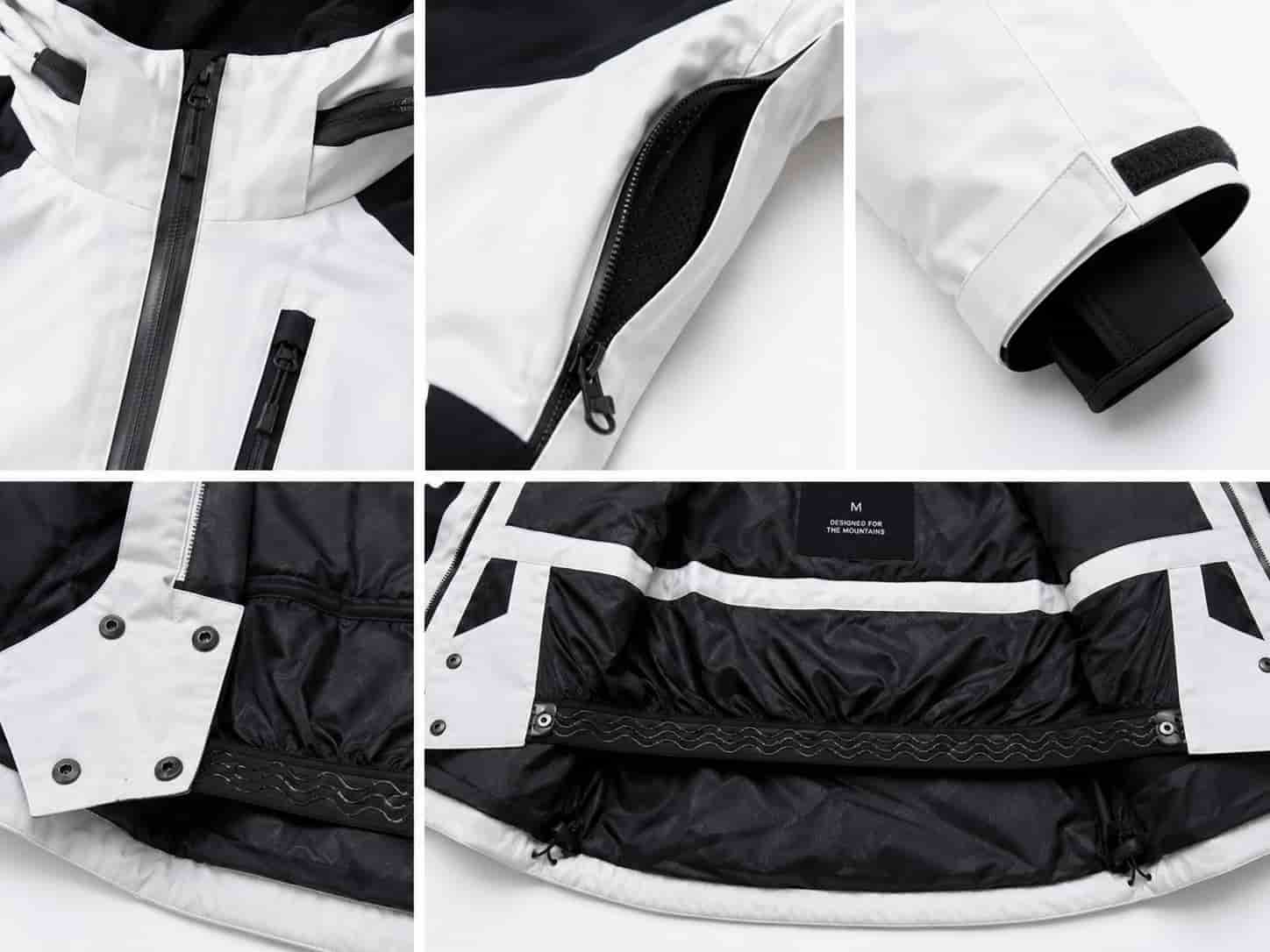
Beyond the shoulders and hood common to general rainwear, ski suits have additional failure points: the crotch seam (constant flexing and contact with snow when seated on a lift or kneeling), cuffs (repeated glove contact and snow packing), and the hem (snow contact when falling). These areas should be reviewed specifically during sample approval, not assumed to be covered by "the same tape as everywhere else."
A powder skirt (an internal elastic gasket at the waist that seals against the base layer or pants) prevents snow from entering during falls. Snow gaiters — cuffs with grip elastic sewn into pant hems — keep snow from riding up the leg. These are ski‑suit‑specific components that buyers unfamiliar with the category often don't think to ask about, but they directly affect whether the finished product performs as marketed.

Skiing involves a larger and more repetitive range of motion than most outerwear needs to accommodate — deep knee bends, raised arms with poles, and constant torso rotation. A pattern copied from a standard jacket or pant will restrict movement and pull at the seams under repeated use.
Pre‑curved sleeves and gusseted underarms allow arm movement without the jacket riding up. Pre‑bent or articulated knee panels reduce fabric pull during flexion. These are 3D pattern‑making decisions, not fabric choices, and they should be part of the initial tech pack discussion rather than a late‑stage fix after the first sample doesn't fit right during movement testing.
One‑piece suits offer continuous protection but are harder to size (a single size has to fit torso and leg length proportions simultaneously) and less convenient for bathroom breaks and temperature adjustment. Two‑piece suits are more forgiving to size and merchandise but require attention to where the jacket and pants meet, so the powder skirt and pant rise are compatible.
| Component | Cost Driver | What Brands Should Confirm |
|---|---|---|
| Insulation | Fill type and fill weight by zone | Zone specific gsm instead of average garment fill |
| Seam sealing | Coverage scope | Fully taped or critical seam sealing requirements |
| Shell fabric | Waterproof rating, breathability and abrasion resistance | Test method and target performance |
| Pattern construction | Articulated panels and 3D cutting | Ski specific mobility requirements |
| Snow components | Powder skirt, snow gaiters, reinforced areas | Included components and customization options |
| Style structure | One piece or two piece design | MOQ and production complexity |
RUINIU has experience developing custom ski wear programs for international winter sports brands, covering insulation selection, seam‑sealing scope, and fit adjustments across multi‑style programs.
It depends on the use case. Synthetic insulation is common because it retains warmth when wet, which matters for a high‑perspiration, snow‑contact activity. Down offers better warmth‑to‑weight for drier, colder conditions, and hybrid builds combine both by zone. There is no single "best" — the right answer depends on target climate and price point.
Ski suits generally require a higher MOQ per style and color than simpler outerwear, due to the added components (insulation, powder skirt, reinforced panels) and pattern complexity. Confirm MOQ by style and color directly with your factory rather than assuming it matches simpler jacket categories.
Not automatically, but buyers should ask specifically. Full seam sealing is more common in ski suits than in general water‑resistant outerwear because of sustained snow contact, but the scope (fully taped vs. critical seams only) should be written into the specification, not assumed.
Yes. OEM ski suit development can include fabric selection, pattern adjustment, colors, trims, labels and packaging according to your brand requirements. Custom development should start with a tech pack or reference sample.
Developing a ski wear collection? Share your target market, expected quantity and reference design. Our team can review suitable fabrics, construction options and production feasibility. See also our Women's Ski Suit product page for style‑specific options.
Send over your tech‑pack, reference samples or product brief. Our OEM team based in Foshan, China supports custom ski wear development from fabric sourcing, pattern adjustment to bulk production.
Request Ski Suit OEM Quotation