
Updated November 4, 2026 | By RUINIU Quality & OEM Team| By RUINIU Quality & OEM Team
Specify the fabric composition, GSM, stretch direction, backing, water-repellent finish and any waterproof or breathability target with its test method. Then confirm garment details, approval stages, packaging and delivery terms. RUINIU standard sample development is 7–10 working days after the tech pack and key specifications are confirmed. Standard bulk production is 35–50 working days after the pre-production sample, materials and order details are confirmed. MOQ is 100 pieces per style per color.
A custom softshell jacket should be specified through the fabric construction, garment details, testing requirements and production terms. Confirming these items before the first prototype reduces avoidable sampling rounds and prevents performance claims that the finished garment cannot support. See our custom softshell jackets.
In this guide
Softshell usually refers to a stretch woven face fabric combined with a fleece, membrane or other backing construction.
Construction | Description | Typical application |
|---|---|---|
3-layer softshell | Face fabric, membrane and inner knit | Technical alpine and ski touring |
Bonded fleece softshell | Face fabric bonded to a fleece backer | Hiking, travel and lifestyle |
Stretch woven with DWR | Woven fabric with a water-repellent finish | Active sports and trail running |
Hardface softshell | Durable face fabric bonded to a backing | High-abrasion outdoor use |
The specification should state fiber composition, GSM and allowed tolerance, stretch direction, stretch recovery, backing or membrane construction, color standard and DWR finish. If PFAS-free DWR is required, state it before fabric approval.
Since 10 October 2026, Regulation (EU) 2024/2462 restricts PFHxA, its salts and PFHxA-related substances in textiles used in clothing and related accessories sold to the general public, at limits of 25 ppb for PFHxA and its salts and 1,000 ppb for related substances. Products placed on the market before that date are exempt. Certain categories, such as some category III personal protective equipment, are treated differently, so confirm the scope for workwear. Read Regulation (EU) 2024/2462 on EUR-Lex.
CFM, or cubic feet per minute, measures air permeability: the amount of air passing through fabric under a defined pressure. CFM is different from MVTR, which measures moisture vapor transmission.
CFM range | General use direction |
|---|---|
6–10 CFM | Stronger wind resistance |
18–25 CFM | Balanced airflow and weather protection |
25–30 CFM | Higher air permeability for high-output use |
These are general reference ranges rather than RUINIU test results. The final target should be recorded with the test pressure, test method (for example ASTM D737 for air permeability), laboratory and report date.
If a softshell carries a waterproof claim, write the target figure and test method into the specification.
Fabric target | Typical buyer use |
|---|---|
5,000 mm | Light rain and casual outdoor use |
10,000 mm | Moderate rain, hiking and skiing |
20,000 mm | Stronger protection for demanding outdoor use |
These ratings are common guidance for fabric, not universal product classifications. Seam sealing, zippers, hood construction and garment design also affect the finished result. The final claim should be tied to the agreed test method, such as ISO 811, and verified on the finished garment where required.
For a softshell, a fabric rating does not guarantee that the finished garment holds it after stretching and washing. When a stable 10,000 or 20,000 mm result is the priority, a hardshell is usually the better construction.
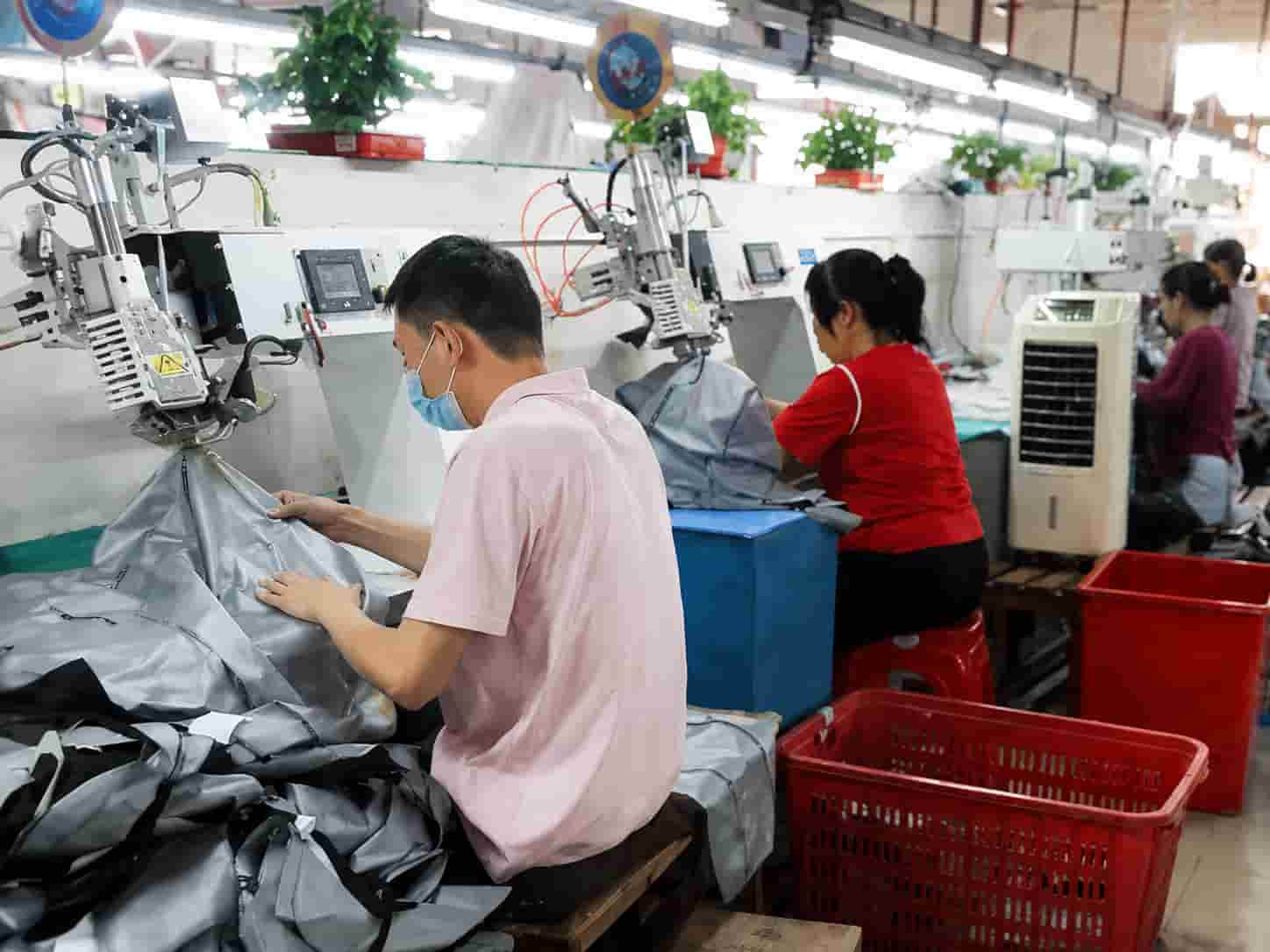
Most softshell jackets use sewn seams without full seam taping. A waterproof softshell may require critical or full seam taping, compatible tape, adjusted temperature, air pressure and machine speed, plus extra control at curved seams and layered intersections.
Our general advice is that full taping is not recommended on a stretch composite, because stretching and washing can lift the tape. When a project requires it, the controls in the case below apply. Our waterproof jacket OEM and seam sealing guide explains how seams are handled.
A UK workwear buyer came to RUINIU for a 3,000-piece custom softshell uniform order. The buyer had previously produced a similar jacket at another factory. After one or two wears, several garments showed water leakage at the seams.
The previous factory had passed a hand-pull check and a spray test. The problem appeared after machine washing and rubbing. The seam tape lifted at the edges, blistered in the middle and caused the hydrostatic-head result to fall below the target. Slanted seams, underarm seams and curved seam intersections were the most difficult areas.
Stretch movement during taping.
Tape stiffness that did not match the fabric.
Uneven seam allowances at multi-layer intersections.
Reliance on a single spray test.
Adjusted tape temperature, pressure and machine speed for the stretch fabric.
Ran curved seams at a slower speed.
Trimmed bulky intersections before taping.
Reviewed the tape type against the fabric batch.
Before bulk production, RUINIU made seam-sealed panels and sample garments for repeated washing and hydrostatic-head testing. The buyer reviewed the samples, tried on the garments and confirmed the construction before approving the 3,000-piece order. The lesson is simple: a softshell jacket that passes one spray test is not automatically durable.
Panel layout and underarm gussets
Articulated patterning
Cuff and hood construction
Pocket placement and zipper model
Logo and label placement
Tech pack or reference sample
Size range and grading
Fit approval method
Planned sample rounds
Fabric testing requirements and target market
Labels and hangtags
Polybag and carton marking
Barcode placement
Care label and country of origin information
For zipper decisions, read our guide to waterproof vs water resistant zippers.
Review the tech pack or reference sample.
Confirm fabric construction and color standard.
Develop the first sample.
Review fit, measurements, stretch and workmanship.
Approve graded measurements.
Make a pre-production sample using bulk materials.
Confirm packaging and production instructions.
Start bulk production with in-line checks and final inspection.
Timelines for sampling and bulk production are listed in the table below. The jacket sample approval guide explains the risks to check before bulk production starts.
Item | RUINIU standard |
|---|---|
MOQ | 100 pieces per style per color |
Sample development | 7–10 working days after technical details are confirmed |
Bulk production | 35–50 working days after the pre-production sample, materials and order details are confirmed |
Packaging | Labels, hangtags, polybags, carton marks and barcode placement confirmed during sampling |
Quality control | In-line checks and final inspection |
Inspection plan | AQL 2.5 where specified in the approved inspection plan |
Third-party pre-shipment inspection can be arranged according to project requirements. The sampling rules behind AQL are explained in our AQL and final inspection guide, and our checkpoints are listed on the quality control page.
RUINIU's standard MOQ is 100 pieces per style per color. Custom colors or special fabric constructions may require separate material confirmation.
Standard sample development takes 7–10 working days after the tech pack and key specifications are confirmed.
Standard bulk production takes 35–50 working days after the pre-production sample, materials and order details are confirmed.
PFAS-free DWR is available on request. The target market and applicable fabric documentation should be confirmed before material approval.
Yes. RUINIU works from tech packs, sketches, reference samples and existing garments. The factory reviews feasibility before development and quotation. See our guide on protecting your clothing design when working with an OEM manufacturer.
Yes. Third-party pre-shipment inspection can be arranged according to project requirements.
Send your tech pack or reference sample with intended use, fabric target, color range, size breakdown, branding details, quantity and required delivery date. See our custom softshell jackets for style references.
Waterproof Jacket OEM and Seam Sealing GuideWaterproof vs Water Resistant ZippersJacket Sample Approval 6 RisksInformation Needed for an OEM Quote